
Canada-EU alliance an opportunity to renew global climate leadership – think tank
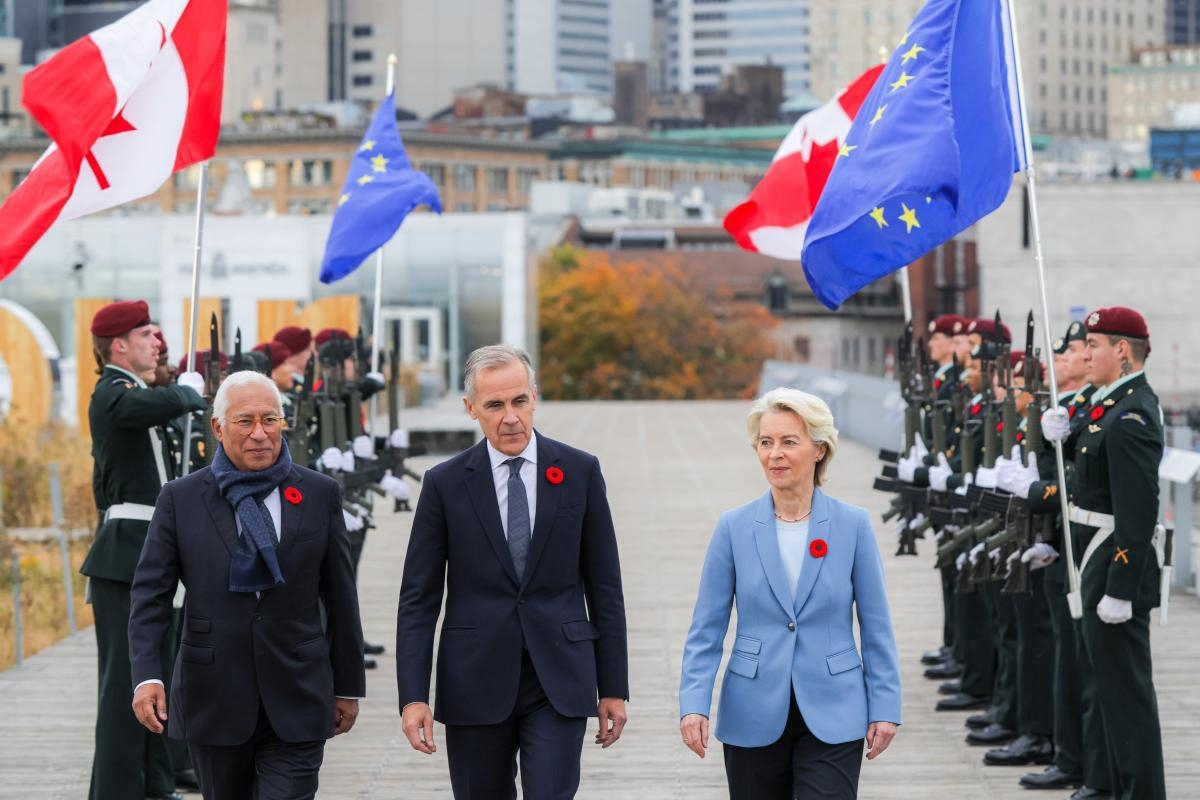
Clean Energy Wire: Against the backdrop of geopolitical tensions and the break with the US, Canada and the EU have decided to work together more closely. Where do you see the biggest opportunities when it comes to climate for the two to work together?
Rick Smith: There are many. Let’s start off by reminding ourselves that Canada and the EU already have well-developed, very detailed agreements with climate as a significant component, such as the Canada-Europe Free Trade Agreement. The Green Alliance Agreement of 2023 is a very ambitious, very detailed document that we have yet to flesh out.
This moment is an opportunity to make good on commitments that already exist to each other, to build an EU-Canada leadership on climate change and clean energy and clean growth in the world. On a high level, there is an opportunity for EU-Canada leadership to kickstart a renewed multilateralism, renewed climate progress globally.
And then we can get as detailed as we want in terms of the policy opportunities: aligning electric vehicle standards, aligning regulation related to any number of consumer products that we want to increase the uptake of in Canada and the EU, ensuring the interoperability of taxonomies in the EU and our developing taxonomy in Canada, and ensuring alignment in terms of industrial carbon pricing. That’s something that’s a real priority for us in Canada at the moment.
What connects the two regions?
European Commission president Ursula von der Leyen’s recent State of the Union speech struck a chord in Canada. The content of that speech, in terms of climate change adaptation and emissions reduction, is very relevant to us as Canadians.
She had this great evocative line, saying that “the EU and Canada see the world with the same eyes.” And then she went on to catalogue this very distressing summer that Europe has had in terms of wildfires and drought and flooding. Everything she said about the summer that Europe had, you could equally say about the summer that we had in Canada. There’s a terrible yearly rhythm now in our country where you can count on certain large Canadian communities being evacuated because of the threat of wildfires.
The necessity and the opportunity of renewing climate change leadership globally fall on both of us to do together.

In a very disturbed, volatile world, more than anything, this is a values alignment. It’s an alignment of mutual benefits, strategic benefits, and Canada has a lot of what Europe needs, starting with critical minerals.
Around the recent EU-Canada summit there were media reports that Canada is seeking an exemption from the EU carbon border tariff (CBAM) and from deforestation rules. Is this what the budding 'Alliance for the Future' will be about? Will it actually be good for the climate?
If you look at the joint statement from the summit, it was very strong on climate. It said "the Green Alliance remains our compass for advancing decarbonisation." That’s pretty good. And then if you look into that 2023 agreement, it talks about rock-solid leadership for climate progress in the world, it talks about accelerating emissions reduction, it talks about an ongoing commitment to the Paris Accord. We were quite pleased with the climate change wording in that agreement.
This is a negotiation between Canada and the EU, so Canada can ask for an exemption from CBAM, but it’s not going to get it. No other country is getting that. There’s going to be a push and pull here, but we were very encouraged by the wording of that agreement. There’s a lot to build on there.
The joint statement also mentioned possible LNG supplies, saying they would have to be in line with the Paris Agreement and consistent with climate neutrality goals. What does that mean?
It’s just a fact that gas demand in Europe is going down, not up, so we’ll see. Canada is blessed with a lot of natural resources. Yes, oil and gas, but also incredible troves of critical minerals. We’re one of the great clean energy producers in the world.
We’ve just scratched the surface of what this renewed partnership might look like, how it could be of mutual benefit. In the last couple of weeks, I’ve noticed renewed discussion of the possibility of an undersea cable going from Canada to the EU. If you think about unlikely things that have come to pass in the last few years, I’m not sure that’s the most unlikely.
In a very disturbed, volatile world, more than anything, this is a values alignment. It’s an alignment of mutual benefits, strategic benefits, and Canada has a lot of what Europe needs, starting with critical minerals.
LNG was also a big topic during Canadian prime minister Mark Carney’s visit to Berlin in summer 2025. As European demand is set to decrease, does it make sense to build out the infrastructure in Canada now to send LNG to Europe?
Private capital is going to make its own decisions. As a Canadian, what’s important for us is that our country is prosperous in the short, medium, and longer term.
We’re here at the UN climate change conference COP31, and it’s clear that the world needs to achieve net zero by 2050. It’s an atmospheric necessity. Since the blockade of the Strait of Hormuz, we see a dramatic acceleration of decarbonisation around the world, and countries realising that through accelerated deployment of renewable energy they can produce their own electricity within their own borders and not be hostage to disruptions of international global oil and gas supply chains.
I see no barrier to cranking up significant new critical mineral production mining across Canada to saturate European demand at a time when batteries are increasingly ruling the global economy.
Canada is going to have some decisions to make in terms of ensuring a diversity of exports in the short, medium, and longer term. Again, if we look at the wording of this EU-Canada agreement, it spoke to a variety of notional accelerated Canadian exports to Europe. LNG was only one of them.
Critical minerals was another, and both sides said they aimed to create investment and business opportunities. What is important from a climate perspective?
There are opportunities for Europeans, but on the Canadian end of things, we still have nonsensical red tape barriers to European products, including electric vehicles, and heat pumps. There are about two dozen very good, affordable European-made electric vehicles that cannot be sold in Canada at the moment because of ludicrous regulatory snarls. The same is true for a lot of heat pump products in Canada. That’s one very simple, specific example of opportunities that should be opened up in Canada.
Our organisation just did a very big report on critical minerals. I see no barrier to cranking up significant new critical mineral production mining across Canada to saturate European demand at a time when batteries are increasingly ruling the global economy.
Canada is developing the sustainable finance taxonomy. Is there something to be learned from the European experience?
In this regard, Canada is a bit of a laggard, and the only advantage of being one of the last major countries to do this is that we can look at what’s actually working and not working around the world. We look very closely at the European taxonomy, the Australian taxonomy and other instruments around the world. And we’re now moving quickly. We’re hoping to have our taxonomy up and running in 2027. And there’ll be a lot of similarities in terms of its approach to buildings, transportation, energy, with other taxonomies around the world.