

Julian Wettengel is a staff Correspondent for the Clean Energy Wire.
Journalists need protection, support and a shift in approach as AI and platforms change information ecosystems – UN adviser
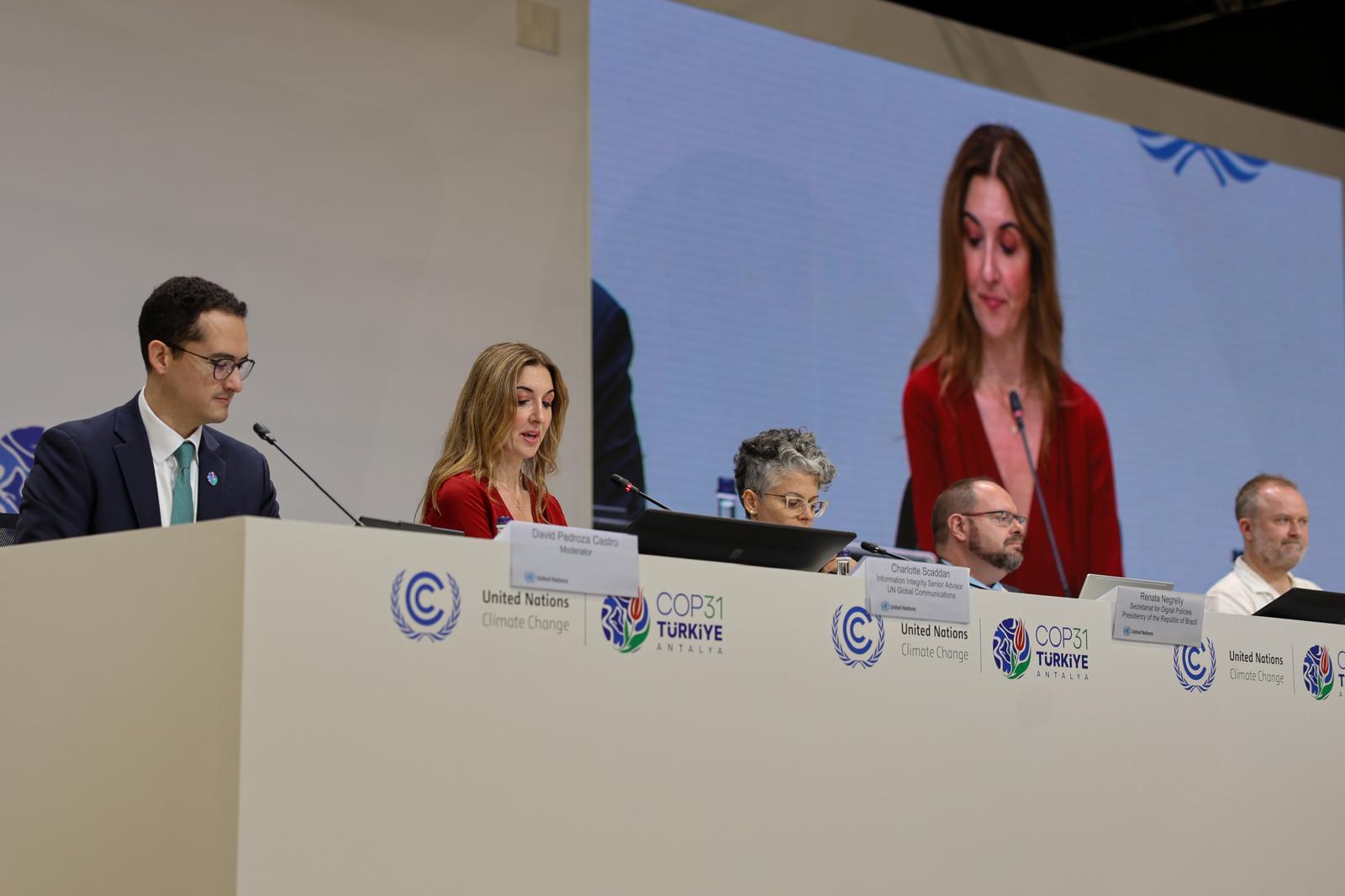
As COP31 draws to a close, climate disinformation has moved from a side conversation to the spotlight. Charlotte Scaddan, senior adviser on information integrity at UN Global Communications, spoke to Clean Energy Wire at the climate conference in Antalya, Turkey, about why the UN is pushing this issue now, what role journalists and governments can play, and how artificial intelligence is reshaping the information landscape, also on climate.
Clean Energy Wire: Disinformation is not a new phenomenon, also not on climate. Why is the UN focusing on it now?
Charlotte Scaddan: It isn’t new, but we have seen it evolve, and this is a problem we became increasingly aware of beyond climate. Several years ago, with the advent of digital technologies and social media, we saw an explosion of disinformation and hate speech, and what we call the three Vs: the volume of disinformation and hate speech that can reach people, the virality, and the velocity, the speed.
UN Secretary-General António Guterres himself foresaw a lot of the risks in the information ecosystem that we’re seeing now, including around artificial intelligence (AI). He became really concerned that we needed to address what was happening in our information landscapes in order to achieve all of the goals of the UN, not just climate.
The pandemic was another moment when the international community realised the risks around misinformation and disinformation.
And climate, of course, has been a big concern for a long time. It’s a UN priority. There really isn’t a more existential crisis. The IPCC report several years ago talked about disinformation as potentially undermining climate action. We realised that something needed to be done, and the Secretary-General asked us to come up with a framework for action on information integrity more broadly, to address misinformation and disinformation.
What we realised in that process was that we need to look at the whole information landscape. It’s not just about disinformation. It’s about all of the tactics that come with it, including hate speech and the targeting of groups. It’s about the lack of access to information that many people have. It’s about algorithmically driven echo chambers that cause polarisation and undermine people’s ability to access a range of information sources, which is a human right. It’s part of freedom of expression.
At the same time, we have the very long-standing issue of censorship and lack of media freedom. But now there is also a lack of public interest media, of media that is independent and able to report on many of these issues, partly because of the digital business model. We saw all of these risks coming together as a big challenge.
Then the government of Brazil was hosting the last climate conference – COP30 – in Belém. They had been a real leader on information integrity around democracy and elections, but realised they needed to address it in the context of climate. They came up with the idea of launching the Global Initiative for Information Integrity on Climate Change that we co-chair with them and UNESCO. That was two years ago at the G20 Leaders’ Summit in Rio de Janeiro.

We call on governments very specifically to support public interest journalism, including around climate.
What is the role of journalism in this information integrity or disinformation space?
Information integrity is not possible without a free, independent and pluralistic media. When we put out the UN Global Principles for Information Integrity, there are five, one of which is indeed for independent media, because it is absolutely essential for a healthy information ecosystem. We could address all of the other risks in the ecosystem, but unless we have robust, quality media, we’re not going to achieve information integrity, quite simply.
And we see that being undermined in terms of the viability of the media business model. I don’t need to tell you that journalists everywhere are struggling.
We see news deserts now all over the world. We also see pressure to narrow coverage, and that has a real impact on environmental journalism. There simply isn’t the money to fund the kind of investigative reporting we need on climate and the environment.
Similarly, sadly, a growing tactic by fossil fuel interests is to target different groups to try to suppress information about climate change. One of those groups, of course, is journalists. We see environmental and climate journalists coming under direct attack and being harassed. Often, they are women, and often those attacks are gendered and happen in the digital sphere. It’s all designed to silence.
Supporting journalism is absolutely key. That is why it’s one of the objectives of the Global Initiative to do everything we can to enable climate journalism, including through some of the projects that we’re funding.
You spoke of struggling journalism. Do you see a role for governments to step in?
Absolutely, yes. We call on governments very specifically to support public interest journalism, including around climate. That’s in the Global Principles, and also in the Belém Declaration on Information Integrity on Climate Change that we launched a year ago, which now has 29 signatories plus the EU.
How can governments do that?
It can happen through funding. That does happen in different countries; obviously there are different models. But it can also happen by addressing the systemic problem of the digital business model. That’s taken up in the new Charter for Climate Information Integrity in Advertising, which was launched here at COP31 and which the initiative is supporting.
One of the things we want to address is the lack of transparency in the digital advertising business model. A lot of money is coming in from brands and advertisers who are funding this business model, and it’s not necessarily being spent well. Their ads may end up next to climate disinformation or other content they would not want to be associated with. And there’s a lot of opacity. Quite incredibly, the brands don’t really know where those ad dollars are going. What we’re saying to them is: demand some transparency. And we’re saying to governments: bring in policies to ensure transparency for advertisers.
When you know how your ad budget is being spent, you can take more control of it and determine which kinds of websites you want to advertise on. You can support quality journalism that way, and we’ve seen a few advertisers doing this. What has been so interesting in the examples we’ve heard from the industry is that their profits have increased and their brand risk has been reduced. It’s a win-win. That’s just one example of a measure that can be taken, but there’s a role for governments there too.
And if we look more at the responsibility of journalism and journalists: a factor you also mentioned is AI. How is it changing the information ecosystem, and what should or could journalists do to navigate these changes?
That’s now one of the newer risks we’re seeing, but also an opportunity. That’s why we launched the Priorities for Action on AI for Climate Information Integrity, and journalism runs through them too. It shows up as a source and as a way of holding AI to account.
As a source, journalism is what AI learns from. But we now see AI summarising and scraping without compensation and without attribution, while drawing people away from the outlets that produce it. If that continues, that reporting dries up, and then AI has nothing reliable left to learn from. This isn’t only a problem for the media business model. It’s an information integrity problem. That’s why the Priorities for Action ask governments to make sure the reporting AI learns from gets paid for, and why we want transparency about where AI is getting its information.
As a check, newsrooms have a role in holding AI’s climate claims to account. We are increasingly seeing AI-generated content that’s presented as “news” but isn’t real news. It’s AI slop, but it’s presented as news, and we want to ensure that we can still have actual quality journalism out there.
And AI’s own climate story is under-reported. Journalists also have a responsibility to report on AI. What is the environmental footprint of AI? And, importantly, how is AI being harnessed by the fossil fuel industry? There are signs it’s used to scale up fossil fuel exploration and extraction, but there is very little data about it and not enough reporting. Journalists can really fill a gap there and ask those tough questions.
You often talk about the entire information ecosystem. Social media and other technologies allow direct communication between experts and the wider population, and the share of journalistic output in the whole information space is getting smaller and smaller. Do journalists need to adapt their way of working in this space, and if so, how?
Absolutely they do. Any communicator, frankly any organisation, needs to adapt the way it works. The information landscape is not what it was ten years ago, or five years ago, or even two years ago. It is changing really fast, and we all have a responsibility to change with it. The way people interact with information has completely changed, and if we don’t change with it, we’re not going to be heard. That’s the same for journalism.
At its core, journalism still needs to strive for accuracy, impartiality and all of the traits of quality journalism. We’re not asking anyone to dumb things down or compromise their principles. It’s really a question of how things are delivered and presented to audiences, in a way that they can understand and that will actually reach them.
I’ve seen some really interesting examples of social media creators being paired with a more traditional journalist who can provide accurate information. It’s still put out as a longer article or a longer TV piece, but it can also be packaged and presented by the creator in a way that very specific audiences on social media can relate to and understand, knowing it’s reliable because it came from the journalist. I think that’s a real win-win combination. Some journalists are doing both themselves, and that’s great if they can. But I think those kinds of partnerships are going to be the way forward.
And then there’s AI. We all have to write in a way that AI is going to pick up accurately. Having the longer piece is really important, but I’ve heard from some journalists, especially those writing about complex scientific climate issues, that they write their own summary at the top – in the hope that the AI summary that appears later will reflect the article more accurately.
It’s about finding practical ways like that. But I think all of us who communicate, the UN included, need a shift in mindset. We can’t be purist about how information reaches people. What matters is that it’s accurate and that it reaches people in whatever form they’re going to relate to.
From what you said about AI and news creators, personalisation is likely to be a big part of it all. People prefer a human experience, and they want to know who is sending them the information. What is your opinion on that?
Yes, it’s about trust at the end of the day. And this is not even new: people respond better to a human being they trust. That could be a social media content creator. It could just as easily be their teacher or their uncle or someone in their community, or even a religious leader. That still holds true. For a climate communicator, it’s really important to use all of those different voices. But those relationships are very much trust-based.
Many content creators have a two-way, trust-based relationship with their audiences. It’s not even an audience, really, because it is a listening exercise. That doesn’t come overnight, and it’s not easy. But it’s much easier for people to buy into that than into a faceless organisation, or even an article they read.