
What are negative emissions?
Negative emissions – commonly known as carbon dioxide removals (CDR), or simply ‘removals’ – are practices or technologies that remove CO2 from the atmosphere and store it permanently.
The CO2 must come from the atmosphere, not from fossil sources such as exhaust gas from coal power plants; storage must be durable; and the removal must result from human intervention that goes beyond Earth’s natural processes, according to the research report “The State of Carbon Dioxide Removal”.
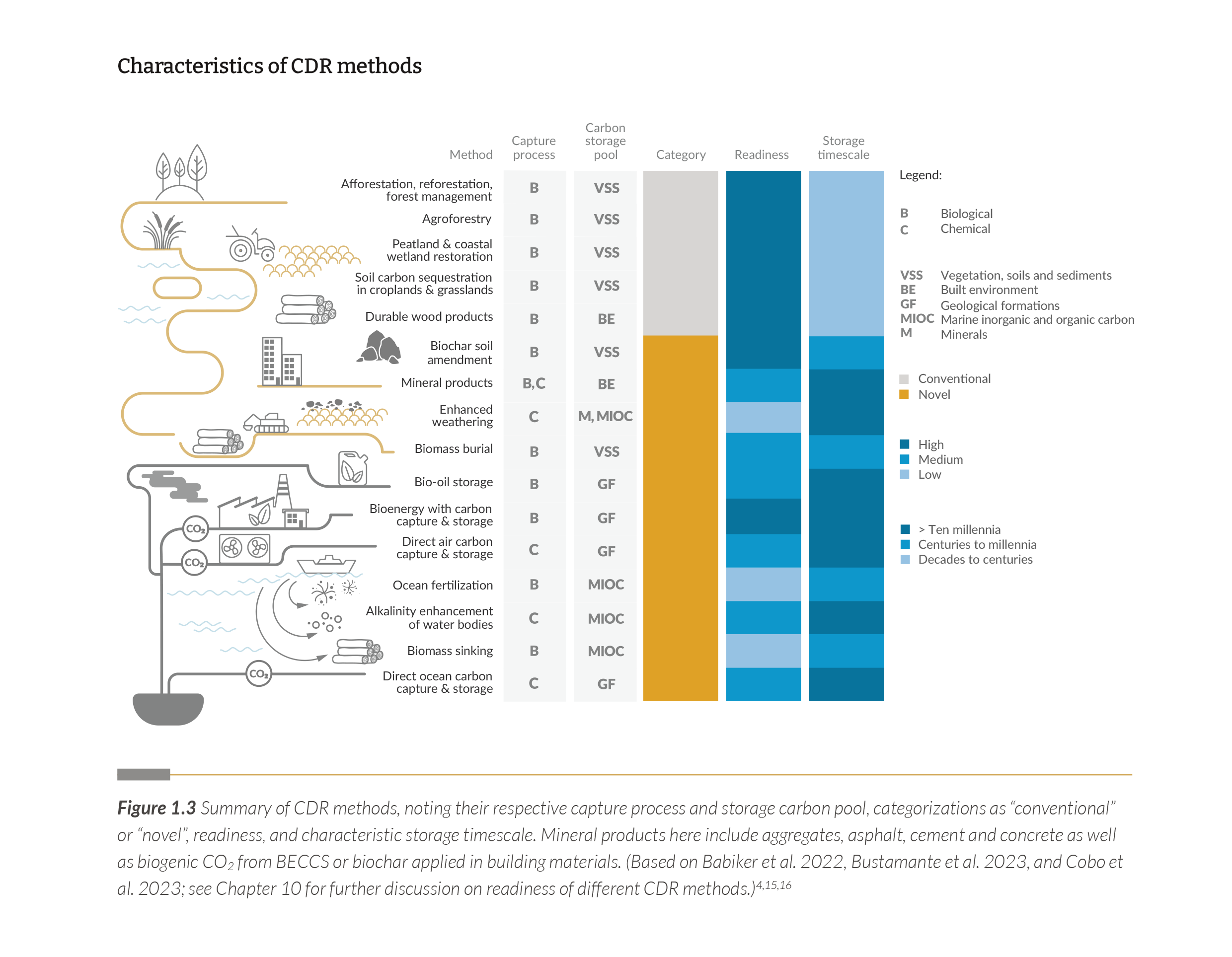
Carbon removal methods can be categorised as “conventional” (e.g. afforestation, reforestation, agroforestry, peatland restoration, and durable wood products), and “novel” CDR methods (e.g. bioenergy with carbon capture and storage – BECCS, direct air carbon capture and storage – DACCS, enhanced weathering, and biochar soil amendment). Today, the only CO2 sinks of significant size are conventional. Novel technologies make up only 0.05 percent of global carbon removals.
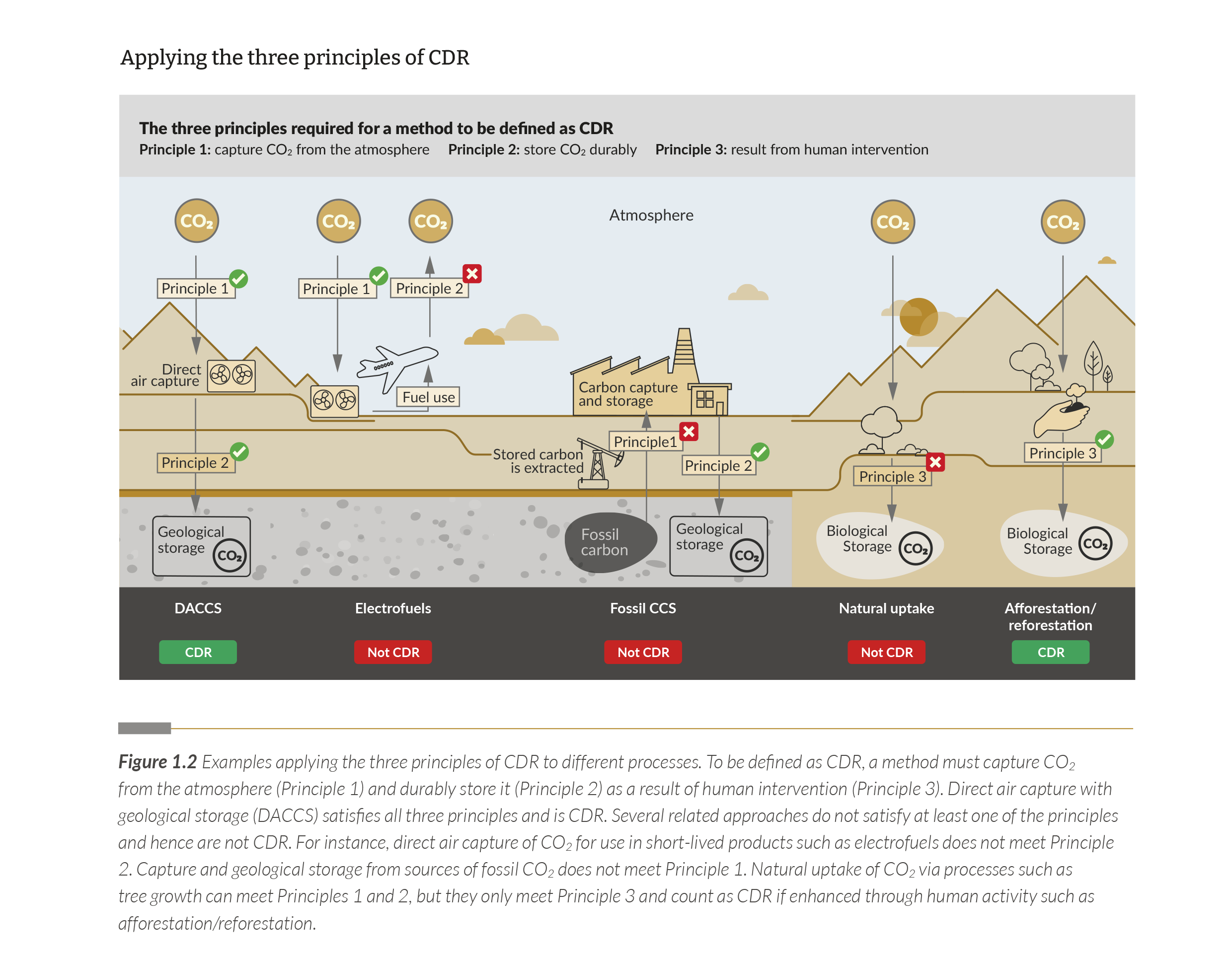
Industrial, or fossil, carbon capture and storage (CCS) or use (CCU) are not considered negative emissions technologies because the CO2 comes from fossil sources – for example when capturing carbon dioxide from burning fossil gas in a power plant, or from a blast furnace used to produce iron - not the atmosphere. However, the technologies will still be of use, for example to transport and store the CO2, so Germany’s recent reform to regulate both would also benefit CDR.
Why do we need carbon removals for climate action?
Reducing the amount of greenhouse gases released into the atmosphere remains the priority to limit climate change. However, removing CO2 from the atmosphere and storing it permanently is set to become an increasingly important part of global efforts, for two reasons.
First, a significant amount of greenhouse gas emissions is considered hard or impossible to abate with current technologies. This is true for certain industrial processes, such as cement production, but also waste incineration or agriculture, such as methane emissions from cattle. This means that to reach Germany’s climate neutrality target by 2045, remaining greenhouse gas emissions must be balanced out either through natural sinks, such as forests, or by technological means. The country’s natural sinks will not be sufficient. Germany’s land use and land use change sector (LULUCF) has been a net emitter of greenhouse gases for years, driven by emissions from drained peatland.
Second, climate researchers expect that global warming will exceed the 1.5°C limit of the Paris Climate Agreement in the 2030s, and that humanity must work towards limiting the period of “overshoot” and bringing temperatures down after a peak – ultimately by removing more carbon from the atmosphere than it emits in greenhouse gases.
However, NGO Bellona also warns of risks and hurdles: Methods for permanent CO₂ removal are often based on technologies that do not yet exist on a large scale, will remain expensive for the foreseeable future and are highly resource-intensive. Depending on the method, they require large areas of land, renewable energy, sustainable biomass or minerals.
Why is the government drafting the strategy?
The government parties said in their 2026 Climate Action Programme that Germany must use carbon removals to reach climate targets. “Negative emissions are crucial to achieving greenhouse gas neutrality and, subsequently, achieving net-negative greenhouse gas emissions,” they said, committing to an aim which is also enshrined in the country’s Climate Action Law.
The law obliges the government to draft the negative emissions strategy. Germany's climate law says the country aims for net-negative emissions after 2050, but does not set a specific target. The law says that the long-term strategy for negative emissions would help deal with “residual emissions which are impossible to avoid”. This strategy would be the legal basis for a government regulation setting targets for “technological” carbon sinks (largely novel technologies) for the years 2035, 2040, and 2045. Germany already has net-negative emissions targets for natural sinks (LULUCF sector) for 2030, 2040 and 2045.
The government also recognises economic potential in carbon removal methods, and wants Germany to be a global leader in the technologies. “It is important to capitalise on the associated economic opportunities, provided that it can be ensured that these technologies have a high level of environmental integrity,” it said in the 2026 Climate Action Programme.
Jochen Flasbarth, state secretary in the environment ministry, has highlighted that the adoption of energy-intensive carbon removal technologies like direct air capture at a large scale would likely happen in other world regions, where renewable electricity is cheaper to produce. This meant that Germany should focus on developing the necessary technologies, “climbing the learning curve faster than others”.
Researchers such as Ottmar Edenhofer, director and chief economist of the Potsdam Institute for Climate Impact Research (PIK), have argued that negative emissions are not an issue for the distant future because investments and relevant regulatory changes must be made or prepared today.
Following the collapse of the previous coalition government, an earlier draft of the strategy was never finalised.
What will the government propose?
The strategy will lay out Germany’s approach to carbon removals, analysing their potential and role in climate action, as well as the demand and technology basics. According to environment minister Carsten Schneider, it is also set to include the planned targets for technical carbon sinks for 2035, 2040 and 2045. The strategy would lay out the government’s actions to scale up carbon removal technologies.
The previous coalition government had published a document containing key elements of the planned strategy in 2024, along with extensive material from a subsequent stakeholder consultation process – but it remains unclear whether, and by how much, Germany’s current leadership will deviate from it. As a major element, the former coalition had planned to introduce a target to have more greenhouse gas emissions removed from the atmosphere by 2060 than are annually emitted, but the new government has not mentioned this since taking office.
How will CDR be financed?
Funding for carbon removals comes from a mix of public and private sources. Many CDR companies today rely on venture capital and private investors, as well as corporate buyers of carbon removal credits in voluntary markets, for instance to reach company climate targets.
However, start-ups such as the German direct air capture company Phlair are betting on future compliance carbon markets, in which businesses would be obliged to buy a carbon removal credit for every tonne of CO2 they emit. This could ensure a solid business case for CDR. Current proposals to integrate carbon removals into the European Union Emissions Trading System (EU ETS) are one example of this approach.
Many carbon removal methods are still in the early stages of research and development, and need to be scaled up to bring down costs. Cost estimates for CDR methods vary widely, from less than 10 US dollars per tonne of CO2 to upper limits exceeding 1,000 US dollars, according to the State of CDR report.
This is where government funding comes in, helping to get the market off the ground. Denmark, for example, has introduced a fund for negative emissions via CCS (NECCS Fund) to support carbon capture and storage from biogenic CO2.
The German government has already announced a subsidy programme due to start in 2027, including support for pilot and demonstration projects to help scale technologies, and a market incentive programme for carbon removal credits.
What do stakeholders demand?
During a comprehensive stakeholder consultation organised by the previous government in 2024, several organisations provided insights into some of the challenges which lay ahead. Industry association BDI said the market ramp-up of carbon removal technologies had to happen “very soon” in light of the target of climate neutrality by 2045, branding existing support as insufficient. It called for “stable funding structures” for a broad range of technologies, and a rapid expansion of CO2 infrastructure.
Energy industry association BDEW warned that emissions reduction, and the expansion of natural carbon sinks, should remain the priority of German climate action. It also called for a consistent alignment of German CDR instruments with EU rules, and called on the government to make cross-border projects possible.
Research initiative CDR terra said that the strategy could provide planning security and make Germany a pioneer of carbon removal technologies. The government must lay out how these could be rolled out at “massive” scale and how to finance it.
Environmental NGO Bellona said the strategy must contain a “robust” definition of what counts as carbon removal technologies, and called for separate targets for emissions reduction, permanent removals, and non-permanent storage. WWF Germany also called for separate targets and warned that emissions reduction should continue to be the top priority in climate action. It added that a clear definition of unavoidable residual emissions was needed to limit CDR to cover these sectors.
In an article for the German Institute for International and Security Affairs (SWP), researchers Felix Schenuit and Domenik Treß highlighted that action is needed in the short term to first help larger CDR projects get off the ground. “The existing framework conditions for companies are generating investment uncertainty, to the extent that there is a ‘valley of death’ that lies between small-scale innovation prototypes and large-scale implementation projects,” they wrote. They called for leveraging synergies between CDR and fossil CCS, an incentive mechanism prioritising low-hanging industrial CDR capacities that can be implemented relatively easily and quickly, and promoting cross-border projects.
Carbon removal industry association DVNE said the strategy would create the foundation for long-term development and set targets. Germany should back a broad portfolio of methods.
Do the EU or other countries have carbon removal policies?
Germany has the potential to make a significant contribution to developing and scaling CDR technologies, but other countries are further ahead on carbon removal policy. Both the EU and several European countries have already implemented rules and programmes. The CDR interest group Carbon Gap has published an overview of existing and planned policies and funding related to carbon removal in Europe.
Countries such as Norway and Denmark are already well-positioned due to their efforts on carbon capture and storage. Denmark’s new government has said it aims to enshrine into law the previous government’s plan to raise the country’s climate target to 110 percent reduction by 2050. Carbon Gap said that Denmark’s Energy Technology Development and Demonstration Programme (EUDP) has for years provided funding for demonstrating innovative CO2 storage and direct air capture technologies.
The European Union also sees carbon removals as essential for reaching greenhouse gas neutrality by 2050, and net-negative emissions thereafter. It has adopted several policies, such as the Carbon Removals and Carbon Farming (CRCF) Regulation, which creates the first EU-wide voluntary certification framework. The LULUCF regulation sets a binding EU-wide 2030 target of 310 million tonnes of CO2 equivalents in net removals, as well as member state targets. The European Commission in July 2026 proposed including permanent carbon removals into the EU ETS to allow flexibility in reaching the 2040 climate target, since it argues some emissions will be cheaper to offset through removals than to abate directly.
When will the strategy be presented?
At the end of July 2026, a spokesperson of the environment ministry told Clean Energy Wire that the department would shortly coordinate the draft strategy with other ministries, with the aim to secure a full cabinet decision by the end of September 2026.