
EU should reform carbon market to include direct air capture, the “gold standard” for removals – start-up CEO
This text is part of our package about frontier climate technologies. If you want more details on direct air capture, check out our in-depth Q&A with scientific background and links to further material.
Clean Energy Wire: The German government has said it wants to make Germany a world market leader in carbon removal technologies, such as direct air capture (DAC). Is this realistic?

Malte Feucht: I believe it is realistic, but it requires consistency. Will we build very large-scale DAC facilities in Germany? I don’t know. But we can certainly develop the technologies and become the technology leader and supplier for Europe and beyond. There are many hidden champions in Germany whose businesses – for example in measuring or sensor technology – are not solely domestic, but global. We need to adopt this mindset.
Where do you see the main competitors?
We stay very focused on our own strategy and don't spend much time watching the competition. Of course, there are other companies in the space, like Swiss Climeworks and Oxy in Texas. Worldwide, there are nine companies with significant offtake agreements, eight of which are using thermal approaches that require a lot of energy for baseload operations. We are the only electrochemical DAC company with significant offtakes and enjoy the trust of customers like JPMorgan and Google.
What sets your technology apart?
DAC encompasses a range of technology combinations. Fundamentally, every process involves a CO2 absorption agent, which can be solid or liquid. But the energy intensive step is CO2 desorption, the release of the captured CO2 as a gas for downstream use. We have developed a proprietary “Hydrolyzer”, that runs fully on electricity and uses less energy than conventional DAC approaches. Unlike other technologies, it can be ramped up and down depending on the availability of clean and cheap electricity. The fact that we enjoy the trust of customers like JPMorgan and Google, I see as a vote of confidence in our differentiated approach – leveraging intermittent electricity can fundamentally change the cost economics of DAC.

There is good reason to believe DAC will see significant cost decreases in the next five to seven years.
DAC is considered one of the most expensive carbon dioxide removal technologies. What drives the costs, and do you hope that DAC will become cost-competitive in the future?
DAC is one of the most scalable, verifiable, and permanent CDR technologies – widely considered the gold standard. The market has lost trust due to overly aggressive cost and scaling promises. If the DAC industry can achieve costs below 200 euros per tonne of CO2 in the long term, it will be attractive compared to other methods like afforestation certificates, which are less permanent and harder to verify.
However, as with every nascent technology, it is currently expensive and not yet at scale. If we look back at solar energy in the 2000s, it was not cost-effective either. Today, solar is one of the cheapest forms of electricity, but it took decades. There is good reason to believe DAC will see significant cost decreases in the next five to seven years. Ultimately, you must deploy to learn and reduce cost, which is what we are doing.
How does Phlair make money today, and what is your vision for future revenue streams?
Our vision is to enable a carbon negative future. But you can only get there by serving customers that benefit from our product. Our mission is to develop the most cost-effective direct air capture technology to deliver CO2 as a gas.
Today, we earn money through voluntary carbon removal certificates. These customers are willing to pay a premium, which helps us scale the technology and operate our facilities. In the future, it won't matter to us what our customers do with the CO2 – whether it's long-term storage, synthetic fuel production, or beverage carbonation. There is a wide range of existing markets where CO2 is already in high-demand – we serve them.
Currently, there is only a voluntary carbon market, so you depend on companies willing to pay?
Absolutely, and those companies are forward-thinking. Customers include Google and WISAG, who can afford to look not only two years into the future, but five or ten. Of course, they buy our certificates today for the carbon removal service, but they also get access to the best technologies and projects so that they have pre-purchase rights later and can be a step ahead of the competition once broader compliance mechanisms are in place.
Microsoft – by far the largest investor in removal credits – recently decided to pause future purchases. What does this mean for the industry, and do you see it as a sign of waning interest?
Industry assessments are clearly above my pay grade. My personal view is that they have bought enough credits to serve their initial commitments and are waiting to see deliveries. That is logical. At the same time, we see other buyers stepping up. Specifically, Phlair's biggest customer – the Frontier buyer group – just announced roughly one billion US dollars in additional commitments to support projects until 2040. They especially want to bridge the phase between purely voluntary and fully established compliance markets. They will back projects that have compliance-grade qualities, such as the ability to integrate into the EU ETS. I think that is the right approach and will move the industry in the right direction: a compliance-grade commodity.
The European Commission is set to present a proposal for a reform of the EU Emissions Trading System (EU ETS), with provisions to include certain carbon removal technologies in the system in the future. What are key aspects the proposal should include?
The integration of permanent removals is essential. DAC is the gold standard, and any reform should reflect that.
What is the start-up environment for DAC technology in Germany?
Germany has all the ingredients to build up a world leader in direct air capture technology. We have fantastic universities and a great vocational training system, which is crucial. We had no problem founding Phlair. My co-founders and I studied at the Technical University of Munich and took the entrepreneurial path. While there are bureaucratic hurdles, overall, Germany is an excellent country in which to build a company. We have all the necessary components; we just need to start thinking bigger.
The government recently announced state support for negative emissions technology. Is that interesting for a start-up like yours?
Absolutely, government incentives are crucial. They are necessary to finance the first demonstration plants, which currently have higher costs per tonne of CO2 than what end customers are willing to pay today. Similar to the feed-in tariffs for solar energy, these incentives will help bridge the gap until DAC becomes cost-competitive.
What is the biggest hurdle for scaling DAC technology, and how is Phlair positioned to overcome it?
DAC is a fundamental technology that will change the world, from carbon removal to synthetic fuels and other industrial use cases. Scaling it requires public-private partnerships and a serious, long-term strategy. Getting clear signals from the regulators is paramount for this industry to continue to unlock private capital.
What are Phlair’s next steps in terms of scaling and technological development?
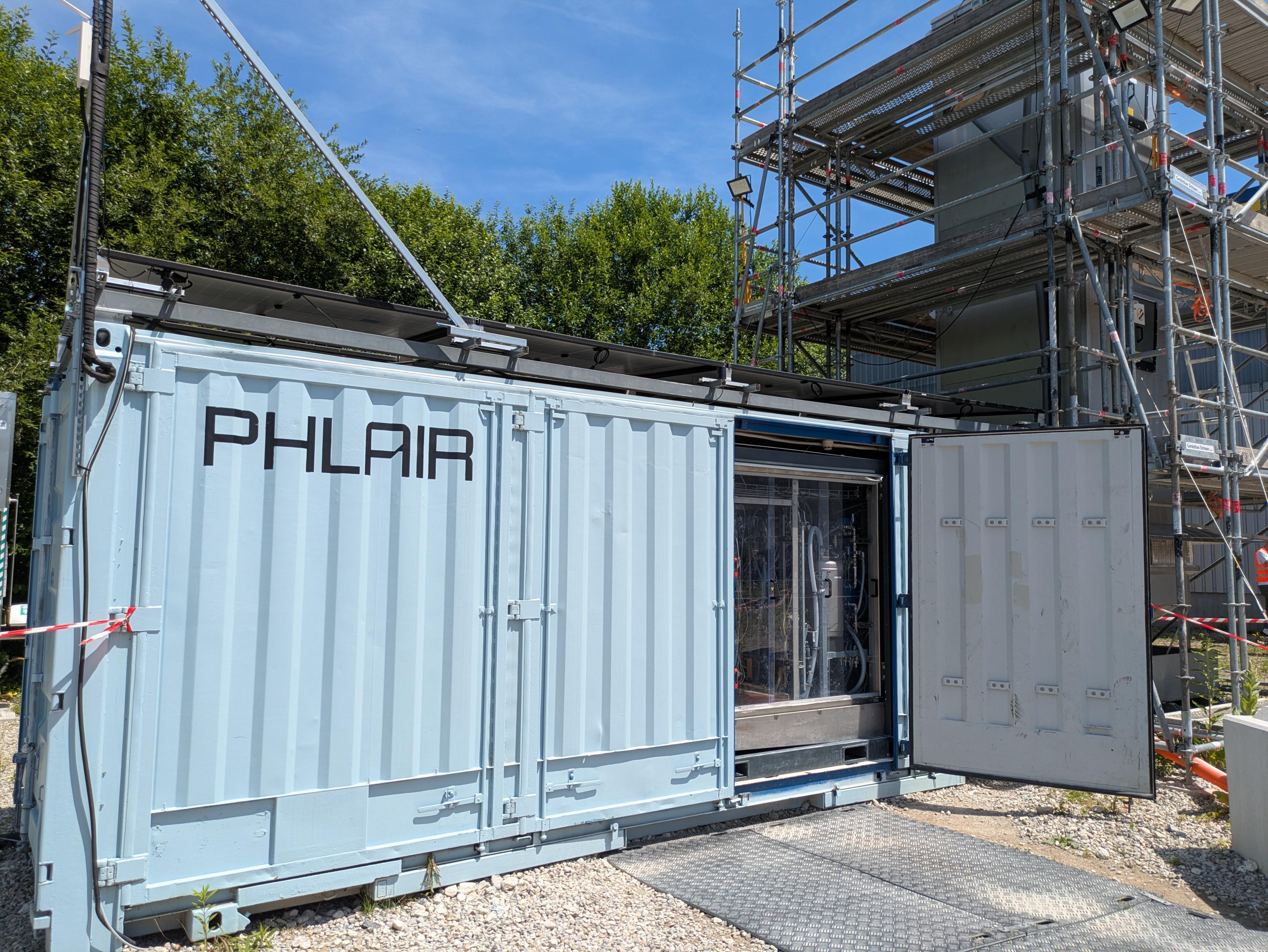
Our next major step is to build a next generation plant that will be 100 times larger than our current pilot facility and will be located in Germany. We will share more details soon. This industrial step is crucial for us to demonstrate the scalability and viability of our technology.
Do you believe that DAC will make a substantial contribution to global climate protection in the future?
Absolutely.