
Q&A: Will Germany’s electricity grid reform slow down the energy transition?
Contents
What is Germany’s grid connection package?
Germany’s cabinet has agreed to change legislation that currently grants renewable power installations privileged access to the electricity grid, in a bid to better align renewable power projects with the grid’s capacity to transport the electricity they produce. The grid connection package from the economy ministry proposed scaling back grid connection priority for new projects, limiting curtailment compensation payments in areas experiencing grid bottlenecks, and partially allowing grid operators to charge renewable investors for grid upgrades.
Priority grid access for renewables is a pillar of the country’s central energy transition legislation, the Renewable Energy Act (EEG). It stipulates that grid operators must not only prioritise connection requests from renewable energy projects, but also guarantees remuneration for the electricity they feed into the grid. This provides investors with planning security and simplifies financing.
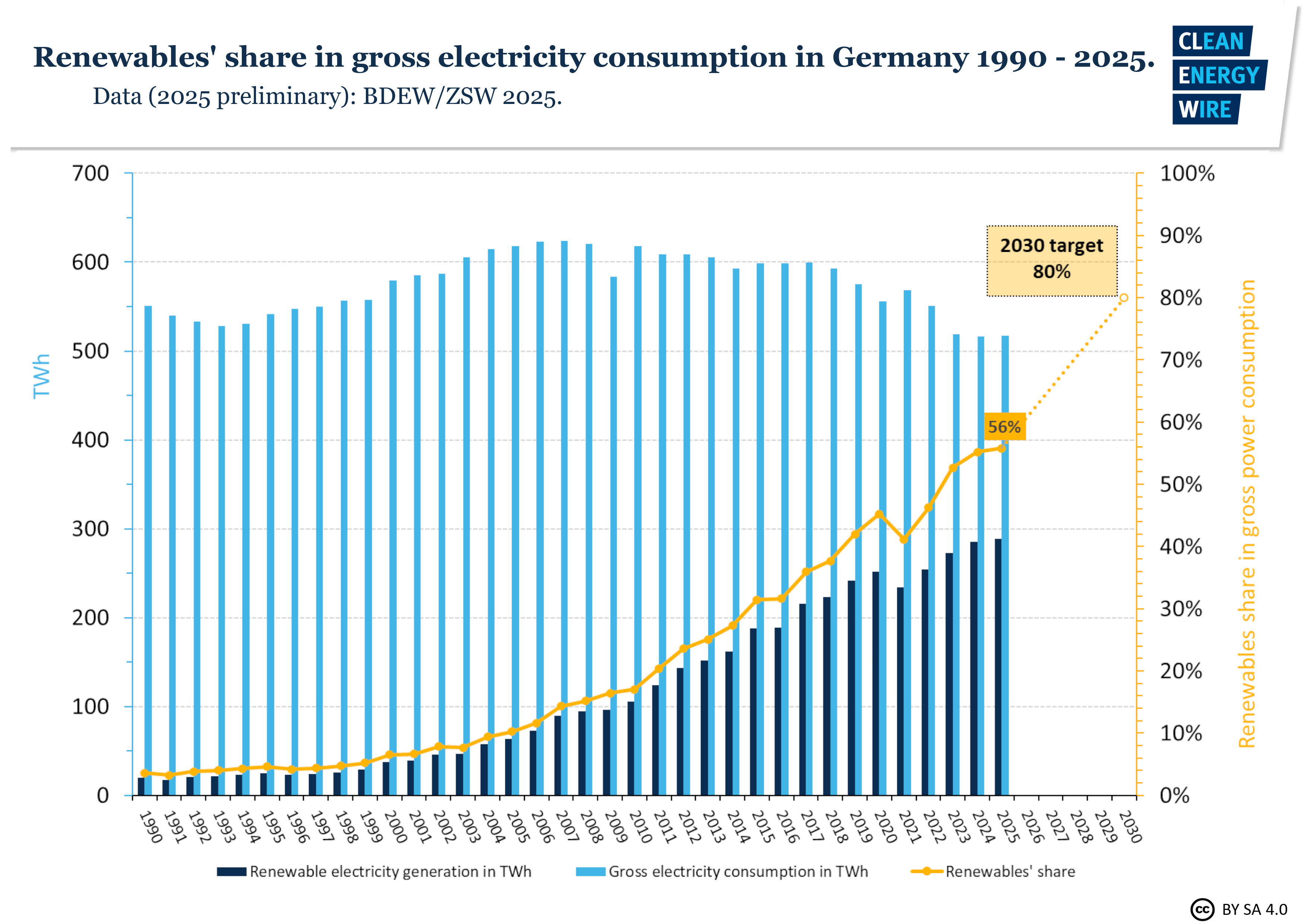
Privileged grid access is seen as a key driver of the progress in Germany’s expansion of renewables, which now cover nearly 60 percent of the country’s electricity demand. However, grids have not kept up with this expansion. Germany is also slow to tap into the potential of making demand more flexible to better align it with fluctuating wind and solar generation, which would ease the burden on the grid.
The proposal is part of wider government plans to reform Germany’s renewable energy support framework, and follows other efforts by the economy ministry to rein in the costs associated with the energy transition.
The proposal is not linked to the European Grid Package, an initiative by the European Commission to speed up the expansion, modernisation and digitalisation of the member states’ grids. As the reforms face parliamentary procedures, changes are still possible.
What is the package meant to achieve?
Germany’s government aims to better align the expansion of wind and solar power installations, power storage, and large electricity consumers with the expansion of grids.
“New power plants should be built where the electricity they generate can be transported and used,” an economy ministry spokesperson told CLEW. It was “no longer appropriate” to guarantee the purchase of electricity from new plants without taking into account the actual generation and grid structure at the local level, the spokesperson added.
The government aims to set incentives so that more renewable electricity is used instead of curtailed, and plans to achieve this by coordinating renewables and grid expansion, arguing that, to date, there is no incentive to account for existing grid bottlenecks when deciding on a project’s location or scope.
“We are creating market-based incentives to ensure that the expansion of renewable energy takes place in more suitable locations,” the ministry wrote in a press release.
It argued that future wind and solar power projects should be built in areas where fewer grid reinforcements are necessary; that they add storage facilities on site to reduce bottlenecks; and that they “take responsibility” for the costs associated with necessary grid expansions – all of which would, in turn, bring electricity costs down for consumers.
Additionally, it plans to enable grid operators to set criteria to prioritise or deprioritise connection requests, differentiating between speculative and serious projects, especially in relation to large-scale battery storage systems. Grid operators have received a “flood of applications” in recent years, with connection requests far surpassing Germany’s total electricity generation capacity – though many projects might not materialise.
The expansion of renewables has made Germany’s electricity mix the cleanest it has ever been and has significantly reduced greenhouse gas emissions.
What are the main proposals?
The coalition government of the Cristian Democrats (CDU) and the Social Democrats (SPD) agreed on a reform package on 29 July 2026.
Compared to a previous draft by the economy ministry (BMWE) from January 2026, support cuts to renewable projects are less severe.
The main provisions in the grid connection package foresee:
- A limit to curtailment compensation to steer the location of new renewable projects: In grid sections that operators designate as “capacity limited”, renewable power investors would have to carry part of the financial risks of potential curtailments.
Specifically, in “hotspots” where more than five percent of the previous year’s electricity generation could not be fed into the grid, renewable investors would only be granted immediate grid connection if they waive compensation for a share of future curtailments for up to six years. - The volume of uncompensated curtailed electricity will be capped at a maximum of 20 percent of annual electricity yield, or 18 percent in wind priority areas. Grid operators are yet to designate the scale of “bottleneck” areas, and must differentiate them based on technology. In areas dominated by photovoltaics, which generate a lot of output around midday, it will still be possible to connect new wind turbines, which have different power generation patterns.
- New rules for grid connections: giving grid operators the power to prioritise not the first projects that request a connection, but projects which would, for example, improve power supply security or help meet renewable expansion targets. Operators can also reserve grid capacity or reduce capacity in a project agreement if it has not been fully utilised over five years.
Connection requests come from renewables, battery storage projects, data centres, and industry. In areas where bottlenecks are likely, a connection might only be granted under a flexibility agreement requiring an operator to adapt feed-in to current grid status, for example by using a battery. - A limit to grid connection capacity for new onshore wind projects and large solar farms: grid connection size will be limited to 70 percent of a project’s total capacity. The limit “provides incentives across Germany for the design of installations that better serve the grid,” according to the reform proposal, for example east or west-facing solar panels, or smaller wind turbines designed for low wind speeds.
- Regionally differentiated grid construction fees, which grid operators can pass on to electricity producers. Involving new renewable projects in the costs of modernising and expanding grids should incentivise them to use scarce grid capacity efficiently, the ministry argued. The “construction levy” could apply to private rooftop photovoltaic modules as well. Grid regulator BNetzA would determine exact rules and locations.
- Digital grid connection processes – from application to commissioning – should be the standard by 2028.
- The obligation for grid operators to modernise and expand networks in line with rising electricity demand remains in place.
Why can’t Germany continue with “business as usual”?
As the share of renewable energy sources in the electricity mix grows, Germany has to figure out how to bring integration costs down while maintaining strong investment incentives.
The legal framework supporting renewables dates back to a time when their contribution made little difference to the overall electricity system. On the path to a future where they play a central role, however, the system needs to adapt. This requires continued incentives for new renewable energy projects, but also parallel investments in transmission and distribution grids, storage, backup capacities, interconnectors, and measures to incentivise flexible electricity demand. The better these individual efforts are coordinated, the lower the required system development costs will be.
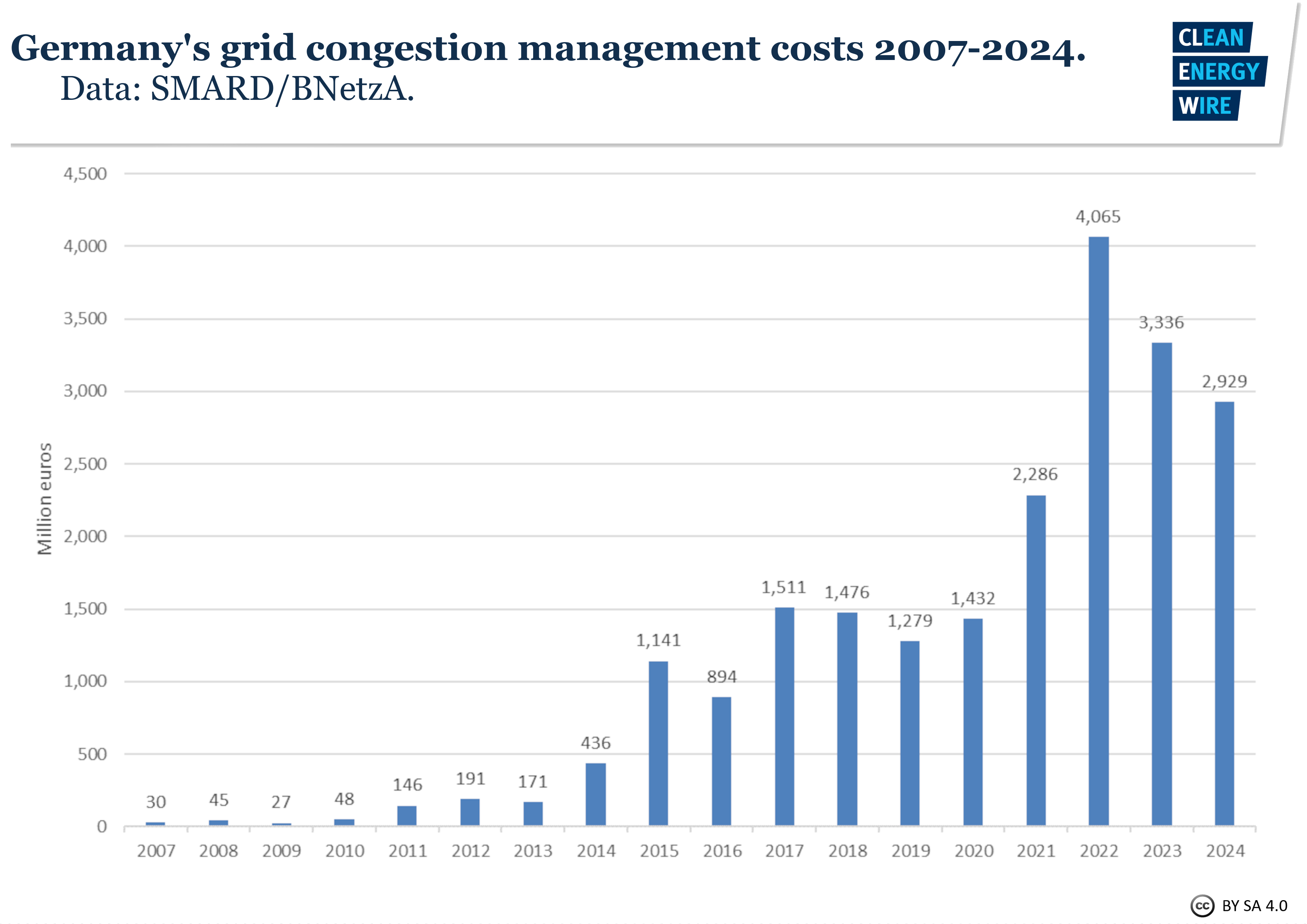
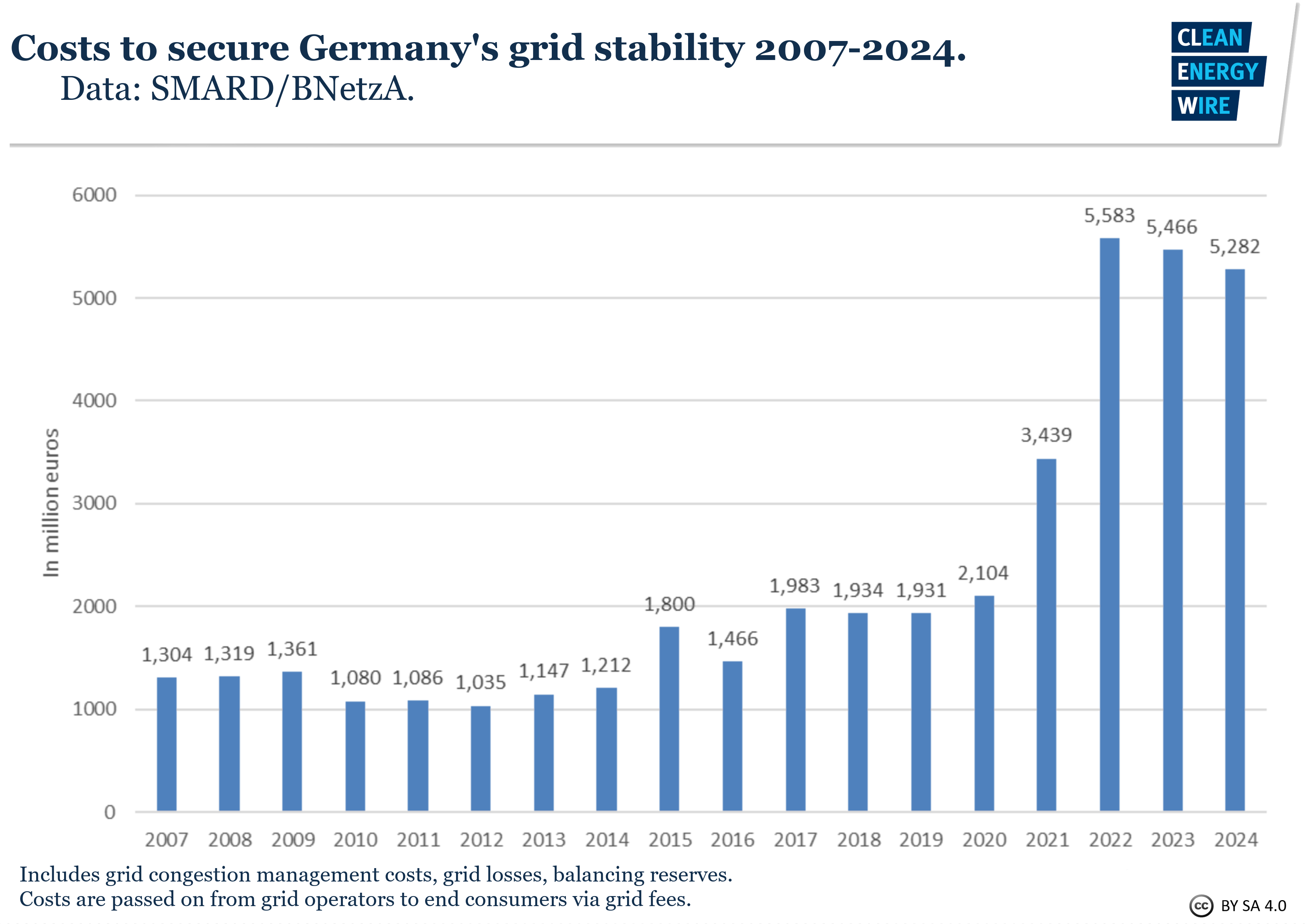
Meanwhile, the costs for grid congestion management, also known as redispatch measures, have reached three billion euros annually, according to the economy ministry. These measures involve deliberately reducing output at some renewable installations while deploying additional capacity in other regions, with curtailed renewables receiving compensation payments.
“We have a structural problem of grid congestion,” said Philipp Hesel, senior associate at Aurora Energy Research. Continuing as usual cannot hold for the future, as it is not system effective and grid operators cannot keep up, he added.
Power market analysts agree that more granular price signals at different times or locations are needed to better align renewable investment and generation with available grid capacity, supporting both reliability and affordability during the transition.
What are the likely effects of the package on Germany’s transition?
According to analysis by Aurora Energy Research, the policy could have a steering effect as to where renewables get built in future. New renewable projects are likely to go to areas without grid capacity restrictions, lowering redispatch volumes and redispatch costs as a result, Aurora's Hesel told Clean Energy Wire.
However, it could also result in additional costs, Hesel added: given the increase in revenue uncertainty, the risk for new renewable projects rises, and therefore financing them becomes more expensive.
“It is a really tricky balance – you might have less redispatch costs, but higher EEG costs,” Hesel said, referring to payments under the Renewable Energy Act (EEG), Germany’s main renewables support scheme. Which effect is larger, and whether there will be a net positive or net negative impact on the overall system, is an open question that depends on many unknowns, he added.
Renewable projects could end up having to carry risks over which they have no direct influence, increasing generation costs – potentially well beyond the savings on the grid side, said Philipp Godron, an electricity policy specialist at think tank Agora Energiewende, in comments to CLEW. According to Godron, grid operators should provide far greater transparency to enable efficient regulation. This would provide much-needed information on grid capacity, connection requests, overload and future projections.
“It is crucial that the designation of ‘capacity-limited grid areas’ is dynamic, transparent and temporary, as the grid situation will change significantly in some cases in the coming years […],” Martin Braun from the energy research institute Fraunhofer IEE told the Science Media Center Germany in February.
A February analysis by Aurora found that bottleneck “hotspots”, locations where more than three percent of the previous year’s possible renewable output had to be curtailed, are currently relatively small. “It is therefore likely that the introduction of a redispatch provision for renewables based on this concept would not directly lead to a widespread loss of redispatch remuneration,” Aurora analyst Lukas Günner told CLEW. However, “the uncertainty this introduces regarding financial viability for projects all over Germany should not be underestimated,” he added.
What is the reaction to the package?
The renewables industry warned early on that the changes, especially the proposal to forgo compensation payments for curtailments, could impact the financial viability of many projects, making it much more difficult to assess their risk profile. By the start of parliamentary discussions in early October, a broad range of stakeholders – ranging from environmentalists to think tanks, and from state premiers to churches – had joined the opposition against the changes, and warned that the reforms would seriously slow the energy transition.
“The cumulative effect of the measures means that, in many cases, project financing is no longer viable and jeopardises the achievement of renewable energy expansion targets,” said renewable energy association BEE.
Clean energy providers called the proposal an "attack on renewables", arguing that, to bring system costs down, the government should prioritise making the most of existing infrastructure, for example by introducing dynamic electricity tariffs.
Energy industry association BDEW welcomed the approach to better synchronise grid and renewables expansion, yet added that renewable expansion needed to remain economically viable and should not be hampered by the cumulative effects of other measures.
Clean energy think tanks are also critical of the reforms. The proposals “would worsen the investment conditions for renewable energy and thus make the energy transition more expensive,” said Julia Bläsius, who heads the think tank Agora Energiewende. She called for binding transparency and grid expansion obligations on grid operators in “capacity limited” areas.
With a view to upcoming parliamentary deliberations, an alliance of Catholic and Protestant church organisations also sharply criticised the plans, arguing they would slow down the energy transition and therefore climate action. "In light of the current and impending setbacks in climate policy, the price fluctuations in the energy sector and the German government’s current course of action, which is exacerbating external energy dependencies, we are raising our voices to draw attention to these political missteps," they said in an unusual “Ecumenical Appeal for a Just Climate and Energy Policy”.
An alliance of renewable industry groups, supported by many environmental organisations including WWF and Greenpeace, organised a demonstration in Berlin on 9 October to protest against the plans, which they said would not only slow the renewables deployment, but also harm employees in the sector and endanger the country’s technological leadership.
Regions with strong renewable industries also joined the calls to stop the reforms. Daniel Günther, state premier of northern Schleswig-Holstein and a member of chancellor Merz’s conservatives (CDU), expressed “his deepest concern” about the changes because they had “the potential to harm the Federal Republic and my federal state”, and called on his party colleague Merz to initiate a change of course.
At a parliamentary hearing on 7 October, the majority of experts called for scrapping the provision limiting curtailment compensation for future renewable projects.
What happens next?
The changes require approval of Germany’s parliament, where they are currently being debated, in conjunction with an overhaul of Germany's main renewable support system – the renewable energy act (EEG). Changes to legislative initiatives are very common at this stage of the process. The exact timeline remains uncertain, as the reforms will also be debated in the state chamber (Bundesrat), which ultimately can’t block the grid package, but could slow the process. The EEG changes require EU approval, whereas the grid package does not. The government wants both in place at the start of the year, and could separate the two initiatives to achieve this.