
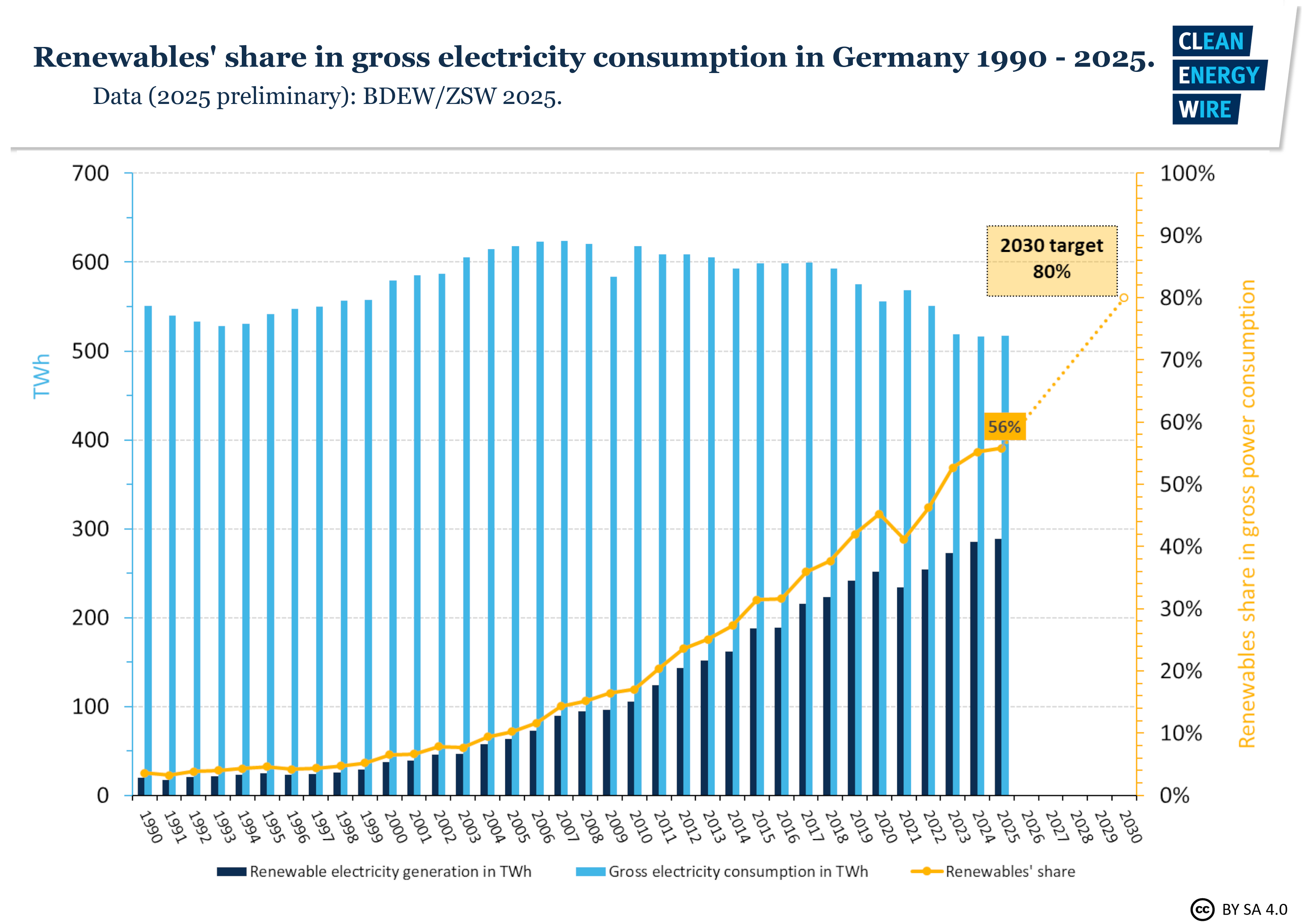
Germany covers nearly 56 percent of 2025 electricity use with renewables
Clean Energy Wire
Renewable energy sources covered nearly 56 percent of Germany’s gross electricity consumption in 2025, according to preliminary figures by energy industry group BDEW and research institute ZSW. Despite a “historically weak” first quarter of the year for wind power production and a significant drop in hydropower output, the share of renewables grew by 0.7 percentage points compared to the previous year thanks to an increase in installed solar power capacity.
Solar power output increased by 18.7 percent over the whole year, while the strong growth in installed capacity from previous years could be sustained, with more than 17 gigawatts (GW) added to the system. With March being the least windy month in Germany since records began in 1950, wind power output, on the other hand, faced a drop of 5.2 percent compared to 2024.
However, stronger winds in the second and third quarter compensated for much of the early-year decrease. Onshore turbines with a capacity of 5.2 GW were added to the grid, a marked increase from the 3.3 GW in the previous year. Due to significantly less precipitation this year compared to 2024, hydropower output dropped by nearly one quarter (24.1%), while remaining only a fraction (3.2%) of total renewable power output.
“The energy transition is the foundation of the adaptability and resilience of our economy,” said BDEW head Kerstin Andreae. Germany therefore must stay the course on expanding renewable power sources. However, in order to back up intermittent renewable power production, auctions for gas-fired power plants and a capacity market were urgently needed, she added.
Frithjof Staiß, head of research institute ZSW, said the strong growth of renewable power sources despite a difficult economic environment showed the sector’s robustness. “But uncertainty about future regulation is growing,” Staiß warned. He urged the government to provide clarity on the support framework for individual technologies, which he said would also accelerate the country’s green hydrogen plans.
Researchers from the government-backed Ariadne research project likewise warned against creating obstacles for a sustained rapid expansion of renewable power capacity. This would result in higher power prices as well as increased dependence on gas-fired power production and electricity imports. The researchers reacted to the government’s monitoring report on the energy transition released in September, which had found great uncertainty regarding projections for the growth of the country’s electricity demand. A slower-than-expected increase is possible, the report showed.
However, to conclude that this allowed for slowing down renewables expansion would be wrong, the Ariadne resesarchers said. Even if reduced support for new wind turbines and solar panels allowed the state to save money, total system costs would increase due to higher consumer prices, they found in a scenario modelling exercise. Moreover, expanding renewables at a slower pace would also lead to higher emissions and put the country at risk of missing its climate targets, they added.
Instead of enabling a longer use of fossil energy sources, policymakers should aim to push flexibility technologies, such as electric vehicles, heat pumps, or batteries. In combination with renewables, these would allow power system costs to fall while maintaining a viable emissions reduction pathway, the researchers said.