
Trump’s shadow looms large over Los Angeles 2028 Olympic green ambitions
*** Please note: this article is part of CLEW’s reporting on climate resilience in the sporting world. You can find the full package here. This project was made possible by a grant from the Checkpoint Charlie Foundation. Follow CLEW for more from this series. ***
Every morning in cafés across Los Angeles, joggers, workers and passersby receive their cold brews and hot americanos in disposable cups, even when sipping them in-house. Sustainability is not a priority for many small businesses in the region, and this doesn't bode well for really big businesses, such as the upcoming 2028 Summer Olympic and Paralympic Games in the city, which will have to figure out how to deliver a clean event in this setting.
As an estimated three million plus sport fans land in Los Angeles for the Olympics in two years, more waste is only one of many sustainability tasks that the city and organisers will need to pay close attention to, and try to mitigate. Local officials and the next Olympics organising committee, the private group LA28, both pledged to step up climate action ahead of the Games by expanding public transport in the car-centric city and “radically reusing” resources by relying only on existing or temporary venues.
The region is dramatically feeling the consequences of climate change: summers are already around 1.5°C hotter than when the city first hosted the Olympics in 1932, almost 100 years ago, and the rate of warming is accelerating. The worst wildfires in LA history in January 2025 ravaged entire neighbourhoods and left tens of thousands displaced.
In principle, each Olympics is meant to outdo the last, sustainability included. LA draws on a strong example from the previous Summer Olympics in Paris 2024, where organisers and the city poured investments into cycle lanes, cleaned up the river Seine and pedestrianised adjacent roads – changes that still benefit the city’s residents today.
Yet people closely involved in LA’s preparations to bring about an event powered by clean electricity, lower transport emissions and a legacy of cooler, greener and more walkable spaces cannot speak publicly about their work.
Delivering more sustainable Olympics as climate change impacts unfold
The International Olympic Committee (IOC), which oversees the running of the Olympic Games, is trying to improve its legacy after years of leaving behind vast stadiums built for a spectacle that lasts only a few weeks and quickly fall into disuse. It has also set goals to reduce its climate-warming greenhouse gas emissions.
The consequences of global warming are already jeopardising the safety of sporting events: extreme heat affects the pace of play and puts athletes and spectators at risk, more intense storms and severe drought damage the stadiums that serve as the backdrop for awe-inspiring performances.
Just this summer, record-breaking heat impaired tennis players and grass pitches alike, and forced race organisers to shorten classic Ironman distances or cancel events altogether. Storm risks have delayed World Cup matches. Tour de France stages were adjusted or sparsely attended as officials asked fans to stay home.
The influx of tourists to cities hosting mega sporting events brings additional dollars, yet it also often comes at high financial and environmental cost and increases pressure on public services. More people in town requires upgraded infrastructure – sometimes at the expense of other projects – to deal with more water use, more waste, more people on the roads and an increased need to transport them.
The city of Los Angeles was awarded the Olympics at the same time as Paris in 2017. The region will have had over a decade to prepare by 2028. It is also closing off the warm-up round: as a host of eight matches during the FIFA World Cup this summer, the city got to test green ideas it hopes to leverage and build on for the bigger event in two years.
LA28 pledged to reduce the operational and construction emissions of its Games by 10 percent compared to the 2024 Paris Olympics, which already cut the event’s overall emissions by around 50 percent compared to recent editions. However, LA’s aim does not account for travel emissions. Global fan travel made up roughly half of Paris’ carbon footprint, and the city benefitted from Europe’s expansive rail network, which LA does not have. Fans will largely need to fly to attend the Games, which significantly worsens their climate score.
Financial pressure to put on the biggest Olympics to date
The pressure to find sponsors is so high that it is hard for the LA Olympics organising committee to meaningfully do something on sustainability, said multiple people with knowledge of preparations who spoke on condition of anonymity. The LA28 team is focused on attracting commercial partners to pay for the Games, on delivering a unique athlete and audience experience, and ensuring public safety, with decisions revolving around those priorities, they added.
When Los Angeles last hosted the Olympics in 1984, the organising committee managed to make a meaningful profit for the first time in the event’s history. As the Games return to the city, LA28 hopes to repeat that success and pledged to cover the costs of an Olympics with more sports and medal events than ever before – needing a budget of 7.1 billion US dollars – through sponsorship deals, ticket sales, and broadcasting rights.
Sustainability is part of the agenda, the people said, but it is towards the bottom of the list and there has been no strategic decision to make it a top-tier priority.
LA28 did not reply to multiple requests for comment by the time of publication.

US president Donald Trump is already influencing sporting events directly, most recently by lobbying FIFA to take back a player’s suspension. However, his impact on sport is also indirect: businesses are reluctant to highlight their climate efforts.
Sponsoring the Olympics, an event watched by billions of people around the world, can be hugely profitable. Still, Los Angeles has no single leading voice championing sustainability and rallying the city behind an ambitious green agenda like Paris had in mayor Anne Hidalgo. Corporate sponsors feel little pressure to supply one given the federal government’s support of a fossil-fuel agenda.
“They don't want to get on the wrong side of the Trump administration,” said Jonathan Parfrey, who heads the non-profit Climate Resolve, which works on climate resilience projects across LA. “Major corporations willing to kick in tens of millions, if not hundreds of millions of dollars in sponsorship are a big target – and so they are a big target for the administration as well.
“Our organisation has seen some of our corporate support drop off because they don't want to be affiliated with a climate organisation any longer. I don’t know if, given the political reality of the United States right now, you’ll be able to generate a lot of funding from corporate sponsorship on sustainability, just by fear of repercussions from the current administration.”
Trump’s fossil-fuel agenda impacts transit progress
Under Trump, the US federal government has aggressively acted against climate and environmental protection, rolling back an unprecedented number of regulations, actively obstructing clean energy, and slashing electric mobility and alternative fuel funding.

Transit agencies are trying to stretch the dollars until the federal government decides to give California, LA and LA Metro money.
Without federal support for clean transportation, dreams of having a green fleet by 2028 are falling by the wayside. LA28 aims to have 100 percent of the buses needed to deliver a public-transport-first Games be “zero or near-zero emissions” – without stating a specific percentage. Yet a lack of federal incentives for electric buses, which are more expensive to manufacture, means that they are in short supply.
“Transit agencies are trying to stretch the dollars until the federal government decides to give California, LA and LA Metro money – they are trying to do it as cheaply as possible,” said Matt Petersen, who heads the Los Angeles Cleantech Incubator, an organisation working to accelerate green technology commercialisation.
Out of the roughly 1,700 additional buses needed to move the influx of sports fans from one record-breaking performance to the next, LA28 has a commitment for 500 to be electric so far. The majority of the supplemental bus fleet will thus likely be “near-zero emissions”, powered by any alternative fuel source compared to traditional diesel – on the lower end of ambition.
Waste questions remain unanswered
Preparations for the Olympics are happening in a context where it is challenging to back green goals with commitments or delivery. Even relatively small issues such as how to deal with the mountains of waste that the millions of visitors will create remain unresolved.
The historic LA Memorial Coliseum will be transformed, once again, into an athletics track for the Olympics. The iconic venue will be the first in the world to host three Olympic Games, having played a central role in 1932 and 1984.
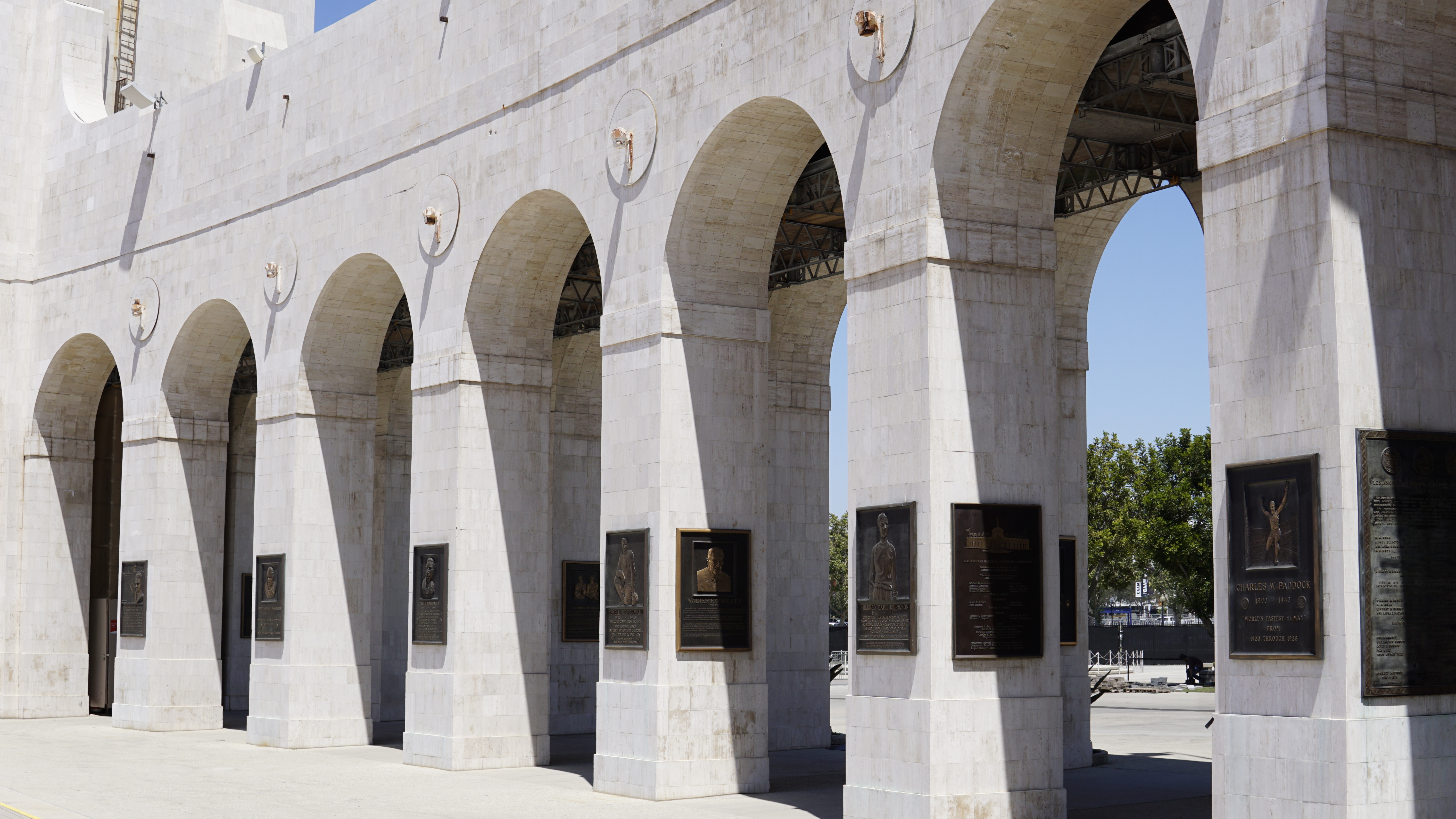
Despite its years, the venue is at the forefront of waste management efforts. The operations team stops 90 percent of game-day waste from landfills during normal operation, and has won multiple awards for it. Yet the Olympics, with its multiple events over back-to-back days, will result in much more waste than the team is used to dealing with.
“We are able to hit our goals because we have the time and the space to sort properly,” said Matthew Buswell, who heads operations and sustainability at the venue. He added that they are is still waiting for an answer from LA28 on how, where or whether his team will sort through Olympic waste.
“Whatever we do is still better than nothing, but we don’t know LA28’s goals for our specific building,” he said. “We have started brainstorming, but we don’t have an answer.”