
Nature gains ground in Europe's efforts to reduce flooding risks
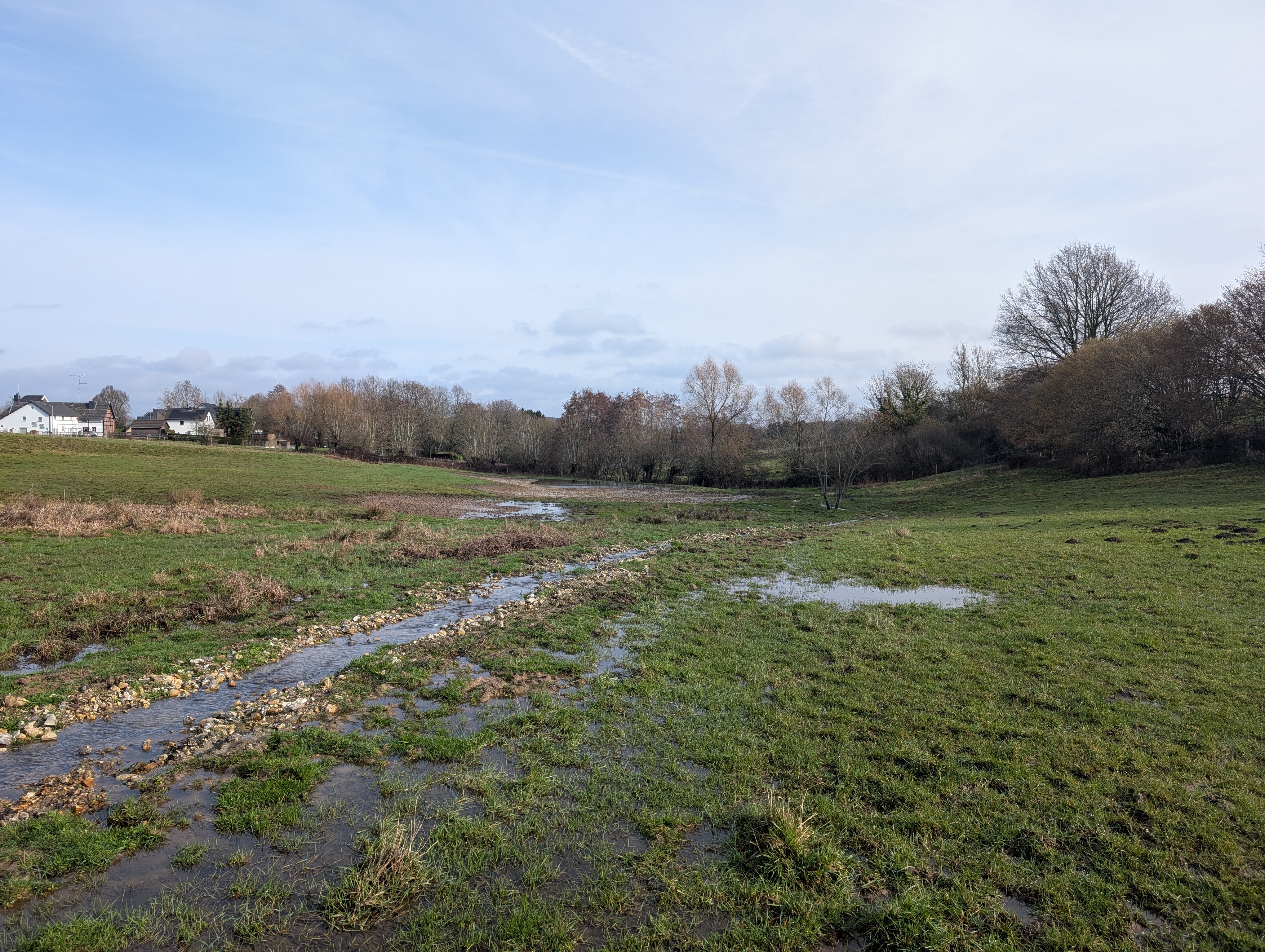
On a cold February morning in a wet, swampy field, not far from the Dutch village of Vaals, Imke Nabben stood with her eyes squinted against the bright sun. A small stream of water – spilling over its own sides in various places – flowed through the field, which was still in the process of absorbing the latest bout of rainfall.
Nabben, who is project leader for nature organisation ARK Rewilding Nederland, explained enthusiastically that the area is a “natural sponge” – a natural landscape that can easily absorb water. These sponges not only lead to more biodiverse landscapes, they can also store carbon and make a valuable contribution to protecting people from floods.
This serene landscape in February 2026 conveys little of what the South Limburg region in the Netherlands experienced in the summer of 2021, when heavy rainfall led to devastating floods that severely damaged homes and local businesses. The experience has been etched into the collective memory of the local population, as well as the realisation that the floods could have done more serious harm. At the time, the real danger could be seen on the other side of the border, as almost 40 people lost their lives in Belgium and close to 200 people died in Germany in floods caused by the same extreme rainfall.
As Europe is warming twice as fast as the global average, climate-related disasters are becoming more common all over the continent. Whereas floods of the magnitude seen in 2021 used to be exceptional in the Meuse-Rhine area, flooding risks are expected to increase as a result of climate change in this region as well.

You have to look for solutions in the entire river basin, in the landscape as a whole. From source to estuary, and from the plateaus to the river valleys.
Bringing back nature, locally
After the floods of 2021, various nature organisations started a collaborative project called Natuurkracht Zuid-Limburg (Nature Force South Limburg), where they implement nature-based solutions (NBS) that aim to improve the landscape’s ability to retain water. The natural sponge near Vaals is just one example of many sites in the area where nature is being used strategically to limit the risks posed by flooding.
Nature-Based Solutions (NBS)
Nature-based solutions (NBS) are measures that make use of natural processes to make natural systems, such as water cycles, more resilient to natural challenges, like flooding and droughts. NBS are inherently holistic, which means that they have a broader effect on the natural world as a whole, since they can affect water flows, but also climate, geological, and ecosystem developments. They are used in climate adaptation, because they have the potential to mitigate climate-related risks.
Local projects have consisted of planting trees and shrubs, raising the beds of brooks and streams, and removing drainage pipes from (former) agricultural fields. All to create more security.
Project leader Nabben explained that flooding can happen in places where the water comes together in the region’s valley landscape when there is a lot of rain. Nabben said that solutions are often sought where flooding is experienced, which is usually in the valleys along brooks and rivers. However, this is usually not where people should look for a solution, she added.
“You have to look for solutions in the entire river basin, in the landscape as a whole,” Nabben told Clean Energy Wire. “From source to estuary, and from the plateaus to the river valleys.”
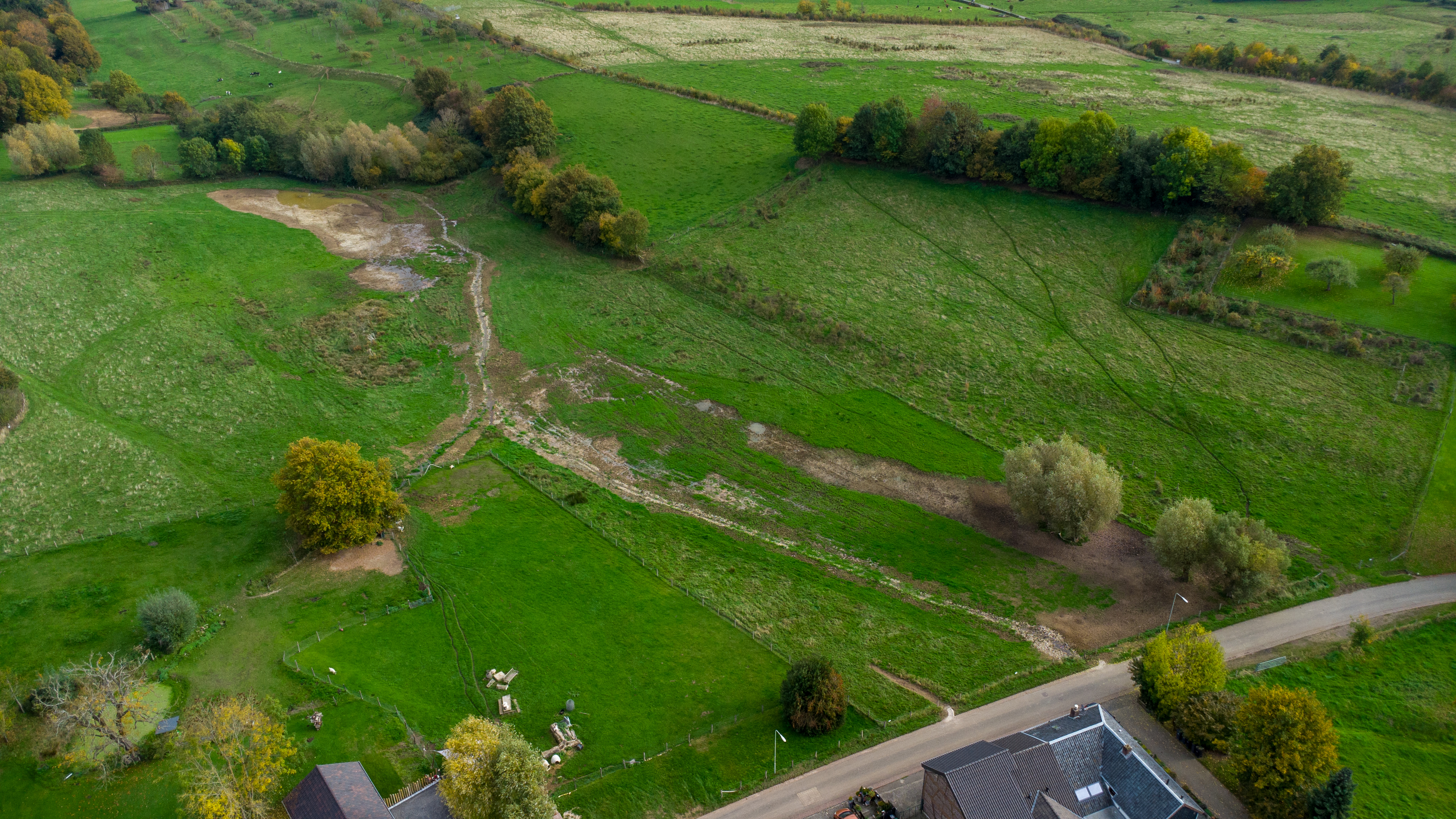
The swampy field near Vaals used to serve as agricultural land, but has now been transformed into a sponge: the clay drainage pipes that used to transport water quickly away from the field have been dug out and removed, and the bottom of the stream that runs directly across the field has been raised, forcing any excess of water to overflow onto the field. These measures stop the water from running off too quickly to lower-lying areas. Across the landscape, cows can graze freely, and Nabben explained that the hoofprints of the cows make the ground more uneven, creating micro-impressions that can also retain more water.
“You can see that the combination of nature-based solutions works,” Nabben said. “It really increases the sponge function of the landscape, and water flows away more slowly. Water is being retained in the places where we implement measures.”
However, it is difficult to say exactly how much water is retained by these local projects, Nabben admitted. This is mostly because it is complicated to quantify the multi-layered effects of the projects within the landscape, she explained. Nevertheless, the project initiators are still looking for ways to demonstrate the effectiveness more clearly in the future.
And of course, we really need each other. The Dutch province of Limburg, for instance, is located downstream. There we are really dependent on the activities that happen upstream.
Going international
Before reaching South Limburg and eventually joining the Meuse-Rhine-Scheldt delta, the Meuse passes through France and Belgium. The river has many tributaries across various borders, including rivers that run through Luxembourg and Germany. As the Meuse connects all of these countries, changes to the course of the river in one place can have upstream and downstream effects. The same principle applies to the Rhine and other smaller rivers in the area. Therefore, those involved in the Natuurkracht project also realised that the work they were doing should not stop at the Belgian or German border.
“We started looking for cross-border cooperation, and we quickly found it,” said Marjon Heutmekers, programme manager for the Natuurkracht project, on behalf of environmental NGO WWF-NL.
Local governments and nature organisations from all three countries decided to join forces within the SPONGE project. The aim of this project - which is co-funded by the EU - is to make use of nature-based solutions across borders to create a landscape that is more resilient to climate change.
Heutmekers, who also coordinates the SPONGE project, explained that cross-border collaboration is very important in spreading awareness of NBS’ added value to landscapes, and exchanging knowledge and local experiences.
“And of course, we really need each other,” Heutmekers said. “The Dutch province of Limburg, for instance, is located downstream. There we are really dependent on the activities that happen upstream.”
The SPONGE project officially started in October 2025, and is scheduled to run until September 2028. Within this timeframe, a variety of local and cross-border projects will be executed.
One location where measures are planned is the Belgian village of Plombières, only seven kilometres from Vaals, on the other side of the border. Similar to what happened in South Limburg, trees and hedges will be planted in open fields, and more space will be created for bodies of water.
Among other things, the measures are intended to reduce the pressure of high water on the lower-lying valleys on the Dutch side of the border, explained project coordinator Didier Bonni from the municipality of Plombières.
“Of course, the aim of these projects is to turn our landscape into a sponge,” Bonni said. “A positive sponge for the water, but also for carbon. A sponge for animals and plants, but also for humans, with some space for the economy, if possible. And it should look nice, of course.”
Nature offers potential, but technology remains essential
Proving the effectiveness of nature-based solutions can be a complex challenge. Studies show that NBS usually influence landscapes in multiple ways, affecting not just water retention in one place, but the water cycle as a whole.
A European Commission report stated that NBS’ potential for flood mitigation is promising, but also that knowledge about the long-term effectiveness of these solutions is still limited. Nature-based projects of which the effectiveness has been proven are often small, such as green rooftops’ ability to retain water. A recent study confirmed there is a shortage of data about the long-term effects of NBS, and comparisons between NBS and so-called “grey solutions” – technological interventions, like dikes and dams. The study also showed that the performance of NBS is uncertain in extreme weather events. Another study emphasised that socioeconomic developments and climate change can influence how effective NBS are in mitigating climate-related risks.
Joan García, professor of environmental engineering at the Technical University of Catalonia in Barcelona and co-editor-in-chief of the academic Nature-Based Solutions journal, argues that NBS are effective tools for risk mitigation.
“With nature-based solutions, you can have the benefits that you could have with other, let's say, more conventional technologies, but using much less energy and having much less impact in terms of CO2 emissions, and emissions of other harmful substances,” professor García explained. “And at the same time, the nature-based solution can create biodiversity, and can help restore ecosystems, or create new ecosystems.”
However, García also emphasised that NBS cannot replace conventional grey technologies completely, and that it is important to remember that NBS are always complementary to dams, dikes, and sluices.
Programme manager Heutmekers added that NBS have many extra benefits that grey solutions do not have. She emphasised that they can also help to boost biodiversity and a more beautiful landscape, which in turn improves the quality of life of the people living in the region and makes the area more attractive for tourists.
“It’s always a bit difficult to explain why we are doing this, because there isn’t one single reason,” Heutmekers explained. “There are just many extra benefits that are directly or indirectly connected to nature-based solutions.”
Project leader Nabben agrees that NBS alone cannot solve the problem of flooding. “Technical solutions will be necessary,” she explained, while drinking a warm cup of tea in a cafe not far from the field with the little stream. “But these technical solutions can be smaller and less drastic, when you use nature-based solutions first.”