
German forests back as carbon sink, but stagnant emissions highlight need for more climate action

Germany’s forests captured almost 20 million tonnes of CO2 more than they emitted in 2025, after severe drought damages turned the sector into a net carbon emitter in recent years, said the Federal Environment Agency (UBA).
“Germany’s forests once again supported climate action efforts,” environment minister Carsten Schneider said. But more had to be done to ensure the development continues in the future, he added. “This positive trend is by no means a foregone conclusion and remains highly dependent on the weather,” the minister said at a joint press conference with UBA. Schneider last year proposed strengthening a government programme on nature-based climate action.
Between 2018 and 2023, German forests were heavily damaged by recurring droughts, bark beetle infestations, storms and forest fires, ultimately turning them into net emitters of carbon dioxide. While many forests since have somewhat recovered, the land use sector as a whole (LULUCF – land use and land use change) remained a net emitter in 2025.
Most emissions in the sector originate from organic soils, primarily from drained peatlands, said the Thünen Institute, which provides data for Germany’s greenhouse gas reporting. Rewetting peatlands therefore remains the key method for significantly reducing greenhouse gas emissions in the LULUCF sector, the institute said.
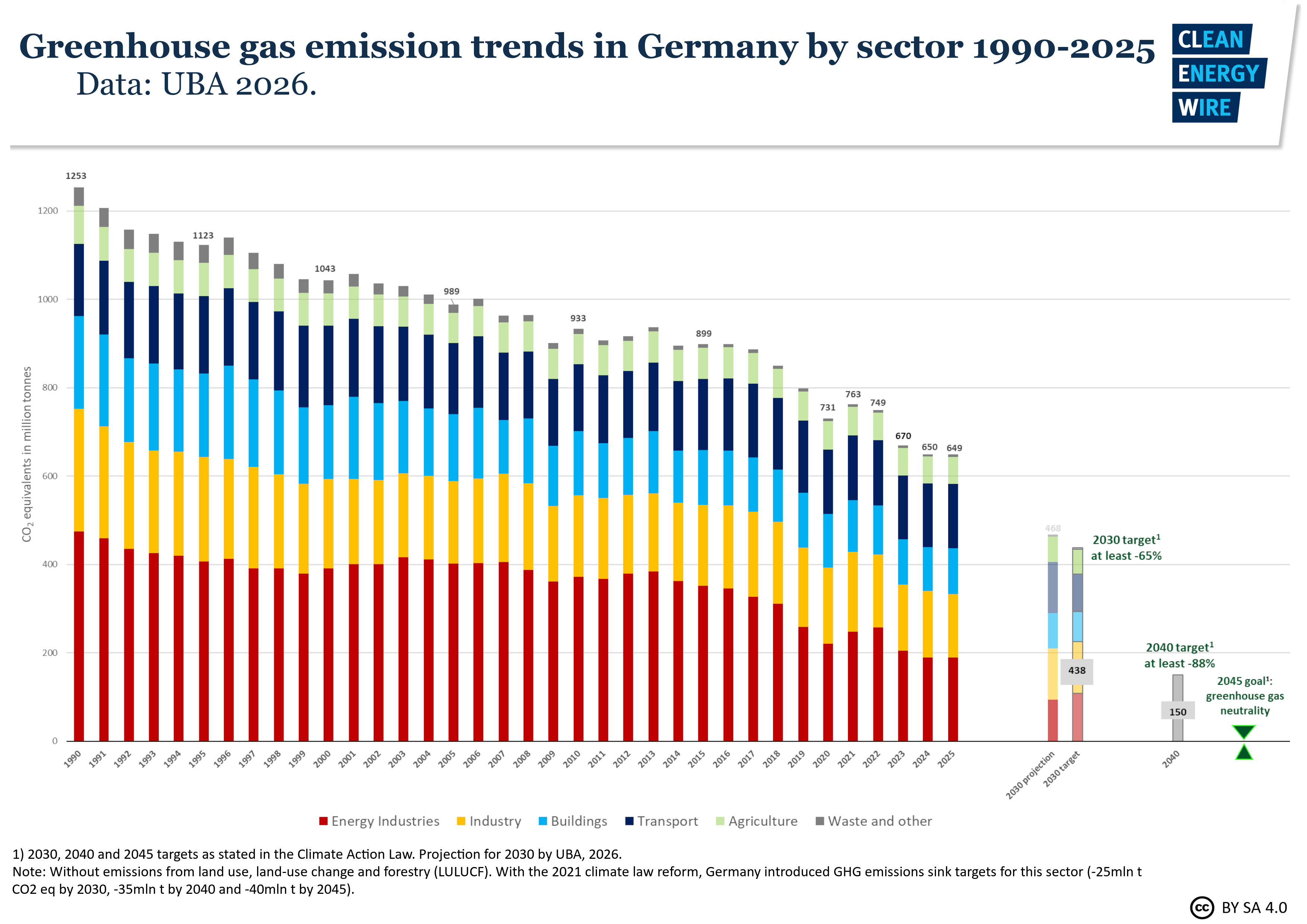
Climate target gap grows as emissions stagnate in 2025
The good news on forests contrasts starkly with emissions developments, or lack thereof, in other sectors.
Total greenhouse gas emissions decreased only by about one million tonnes (0.1%) last year, to 649 million tonnes of CO2 equivalents (CO2 eq.), UBA said. This means Germany has almost halved its emissions since 1990 (-48% in 2025).
However, to reach Germany’s target of reducing emissions by 65 percent by 2030 (compared to 1990), the country must from now on reduce emissions by 42 million tonnes of CO2 eq. per year on average, UBA director Dirk Messner said. “The challenges have become a little harder, but they are not impossible to overcome,” he said. The energy transition and the expansion of renewables remained the “central foundation” for reaching climate targets, UBA said in its report.
Emissions from industry declined mainly due to a stagnating economy, while those in transport and buildings increased compared to 2024, clearly exceeding the annual levels stipulated in the country's Climate Action Law. Sales of transport fuels were on the rise and colder winter temperatures increased the need to heat homes, mostly still with fossil fuels like gas or oil.
Emissions projections for the coming years and decades, also presented by UBA, showed that – with the policies currently in place – Germany would reduce overall emissions only by 62.6 percent by 2030, a slight worsening of the situation compared to last year’s projections. While the energy sector would overachieve its targets, transport and buildings would significantly exceed emissions budgets in the coming years and remain the toughest sectors to decarbonise.
This puts the country increasingly at risk of failing EU-mandated climate targets for the two sectors, and the emissions gap has grown since the previous UBA projections in 2025.
Cabinet to adopt climate policy programme on 25 March – environment minister
The government of chancellor Friedrich Merz has so far failed to present sufficient proposals that would reverse the worsening trend, but a legal deadline is looming. Merz's coalition is required by law to present a new Climate Action Programme before the end of this month, which must spell out in detail how the country plans to reach its 2030 and 2040 climate targets.
The programme will include new proposals, alongside measures which the government proposed in its 2025 coalition agreement or has already adopted in its first months in office. A leaked first draft fell well short of closing the emissions gap.
Minister Schneider said that the government will agree on the final programme in cabinet on 25 March.
While planned instruments like subsidies for EVs could help lower emissions, other decisions by Merz and his cabinet could have the opposite effect, such as softening EU car emissions rules, or the planned reform of Germany’s so-called heating law. Researchers have criticised that the reform could lead to higher emissions in the heating sector than under policies currently in place.
“The buildings sector is and remains the German government’s biggest challenge when it comes to climate policy,” said Barbara Metz, managing director of NGO Environmental Action Germany (DUH). “And instead of finally tackling it, emissions are actually set to rise” due to the planned reform, she said. DUH called on the government to present a programme with effective measures to improve emissions reduction efforts also in other sectors, such as a general speed limit on motorways.
The independent five-person Council of Experts on Climate Change will now assess the UBA emissions projections and present its report by mid-May.