
Q&A: EU Grid Package – How Europe plans to bolster the energy transition’s backbone
***Read our series on how Europe is changing electricity systems to support the energy transition and deliver on its promise of affordable, sustainable and reliable power here.***
What is the European Grids Package?
The European Grids Package is an initiative by the European Commission to speed up the modernisation and expansion of the bloc’s energy grids. While it focuses heavily on electricity, it also covers hydrogen and carbon networks. Reflecting the EU's emphasis on securing industry competitiveness, the package focuses heavily on lowering energy costs.
It has no legal force, but includes legislative proposals as well as non-legal texts to speed up planning and permitting, boost investments, and ultimately support the electrification of sectors that currently rely on fossil fuels. The legislative proposals will now enter negotiations in the European Parliament and the EU Council, the EU institution representing the 27 member states. Adopting EU legislation typically takes several months.
Background | Why does Europe need to strengthen its grids?
Europe aims to be climate neutral by 2050. To achieve this, it is progressively phasing out fossil fuels, and plans to power its economy largely with electricity. To deliver this electricity – which is now generated on balconies, rooftops, fields and windy coasts, replacing large, central power plants – to an increasing number of electric vehicles, heat pumps, and industrial players, the bloc needs to expand and modernise its grids.
While Europe has one of the world’s most reliable power grids, it is increasingly strained by bottlenecks, long connection queues for new renewables, electric vehicle charging infrastructure and industry projects, as well as rising renewable curtailments – when excess wind or solar power cannot be absorbed by the grid and is deliberately reduced. This is costly and slows efforts to decarbonise the economy.
“Europe cannot claim leadership in clean technology if its electricity system cannot supply the power that new industries require,” wrote Carla Hobbs, policy fellow at the European Council on Foreign Relations (ECFR), a think tank.
Moreover, electricity transmission and distribution face heightening threats, ranging from cyber-attacks as grids digitalise to extreme weather driven by climate change.
Why is a European effort needed?
Europe’s grid infrastructure is ageing and poorly interconnected. Modernising it is key for achieving the bloc’s goals of economic growth, decarbonisation, energy independence, and lower energy bills.
“Without massive upgrades, Europe will not be able to offer green and affordable electricity to enough homes and businesses, leaving the green industrial revolution stuck waiting for grid connections,” the European Investment Bank (EIB) wrote. “If Europe wants to maintain climate leadership and economic competitiveness, grid investment must be a top policy priority.”
Thanks to Europe’s interconnected electricity market, electricity can flow across the continent – from Italy to Sweden and from Poland to Croatia. The system is designed so that, as long as there is enough transmission capacity, electricity is generated where it is cheapest and shared across borders.
“Europe’s energy transition demands that we think beyond national borders.”
However, grid planning still takes place largely at national level, with differing deadlines, timelines, scenarios, and methodologies. “That does not always add up to the optimal solution at European level,” said a senior European Commission official. “We see a need for cross-European planning of the grid – that does not mean we want to replace the work done by [Transmission System Operators] TSOs at national level – but we want to add to that a European dimension.”
More coordinated infrastructure planning could significantly reduce the investments needed for the energy transition (see below). However, allocating costs for cross-border projects remains politically sensitive. The EU could create better frameworks to address this, as interconnection projects – such as better links between the Iberian Peninsula to the rest of Europe – have been plagued by delays.
“This is a typical problem with the interconnections,” the senior Commission official added. “It is rather obvious who will gain from it, but it is not always obvious that those who invest in it will benefit equally.”
Implementation will determine the package’s success, climate NGO Clean Air Task Force (CATF) warned. “While much attention focuses on Brussels, powerful levers for progress lie at national, regional, and local levels,” the NGO wrote. “The Grid Package is a test of Europe’s ability to coordinate on critical infrastructure for a shared energy future.”
Background | By the numbers: Why is the EU Grids Package important?
- Renewable curtailment: Across Europe, the cost of cutting renewable electricity output to keep the grids stable, and associated compensation payments, reached 8.9 billion euros in 2024, according to a report by analytics firm Aurora Energy Research. In the same year, 72 terawatt hours (TWh) of mainly renewable electricity was curtailed due to grid bottlenecks – roughly equivalent to Austria’s annual electricity consumption.
- Renewable projects stuck in queues: A report commissioned by climate NGO Beyond Fossil Fuels (BFF) estimated that, in 2024, renewable power projects totalling 1,700 gigawatts (GW) across 16 European countries were stuck in connection queues – more than six times Germany’s total installed generation capacity as of December 2025.
- Closing grid investment gaps: More than half of the transmission projects needed by 2030 are still awaiting permits, according to European transmission grid operator association ENTSO-E. The European Court of Auditors also found that planned investments to expand and modernise the EU's electricity grids by 2050 fall short of what is needed to support the bloc's move to climate neutrality.
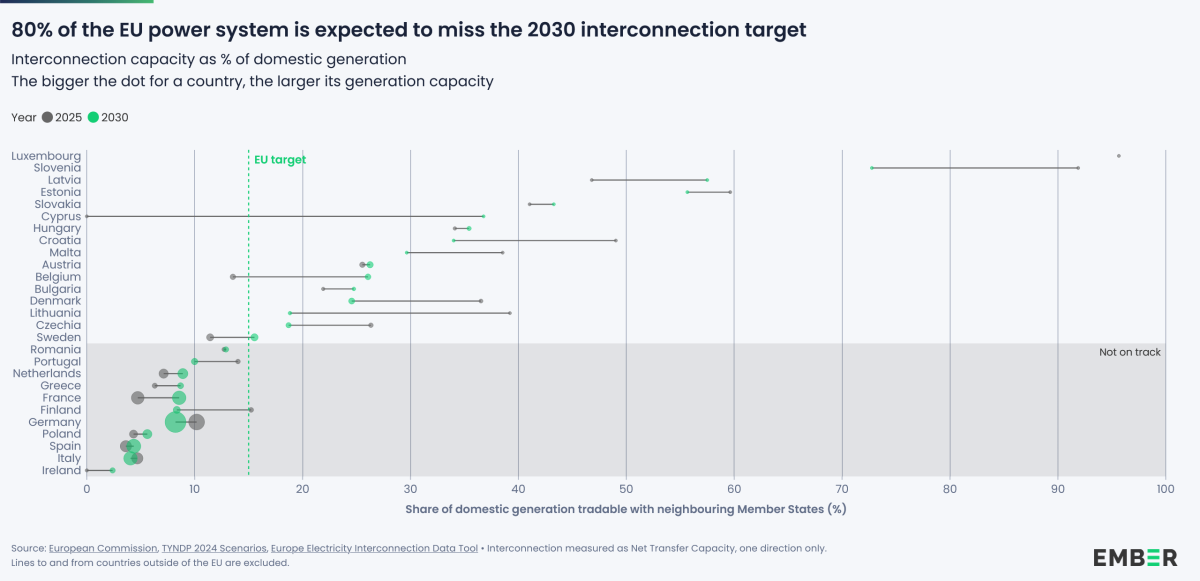
- Getting back on track to meet interconnection targets: Around 80 percent of the EU power system is expected to miss the 2030 interconnection target, which requires countries to have an electricity import capacity equivalent to 15 percent of installed generation capacity, up from ten percent in 2020. “The countries that would benefit most from interconnection are also those expected to have some of the lowest scores by 2030,” a report by think tank Ember concluded.
- Reducing system needs by planning together: An analysis by five European energy think tanks – including Germany’s Agora Energiewende, Poland’s Forum Energii, and Italy’s ECCO – found that developing a joint scenario for energy infrastructure needs by 2050 would require 505 GW less back-up capacity, 15 percent less onshore wind capacity, and 9 percent less hydrogen electrolyser capacity than a nationally focused, sectoral approach. Independent top-down planning was crucial to achieving potential savings of up to 750 billion euros, the researchers said.
- Reducing costs by working together: In the EU’s key infrastructure plan for the future, the Ten-Year Network Development Plan (TYNDP), ENTSO-E concluded that additional cross-border power lines could cut system operating costs and reduce renewable curtailment by 30 TWh per year by 2030 – more than Slovakia’s entire electricity demand in 2023. Europe’s fragmented approach to electricity supply security cost the bloc almost 11 billion euros in 2024, according to the Agency for the Cooperation of Energy Regulators (ACER), which said stronger cross-border coordination could significantly reduce these costs.
What does the Grids Package say?
The European Commission presented the European Grids Package on 10 December 2025. The main proposals include:
Top-down planning:
- The Commission wants to centralise the planning of cross-border infrastructure and develop an EU energy scenario identifying electricity, hydrogen, and carbon infrastructure needs every four years.
- It proposes a mechanism allowing the Commission to step in when no projects to address identified infrastructure gaps come forward.
- Eight “energy highways” deemed strategically important for Europe will receive additional short-term support. Better political coordination should fast-track these projects, which will be prioritised at EU level, the Commission said.
Speed up permitting:
- The Commission proposed changes to EU law allowing governments to exempt grid, storage and renewable repowering projects from requiring environmental impact assessments, citing long delays that can stall projects for years. “Many environmental rules were introduced with the best of intentions, but are not very efficient,” said a negotiator from a Member State, adding that they would now look at what could be done to speed up permitting without placing additional burdens on the environment.
- It also published guidance on efficient grid connections, including filtering requests based on project maturity, setting clear deadlines for project progression, introducing reservation fees, or limiting permitting timelines.
Boost cross-border infrastructure:
- The Commission proposed a “fairer division of costs” for cross-border projects, including electricity interconnectors. Measures include greater transparency and predictability in cost-benefit assessments, also beyond host countries.
- New rules on the use of congestion income to help finance interconnectors, such as requiring TSOs to allocate 25 percent of revenue for projects on the EU list.
Make better use of existing grids:
- The proposals aim to maximise the use of existing infrastructure before building new capacity, including through smart grids, digital technologies, and grid efficiency measures. Network tariffs and connection charges should also reflect this aim.
- Technologies such as dynamic line ratings and power flow controls – which enable operators to transmit more electricity if the weather conditions are favourable, for example – could significantly increase capacity and reduce the need for new construction.
- The Commission also called for better transparency on grid hosting capacity and connection procedures.
Increase grid resilience:
- The Commission proposed integrating both physical and cyber-security considerations early on in cross-border project plans, promoting resilience by design, transparent ownership to avoid “unreliable foreign actors”, and providing support for security upgrades.
Background | What did stakeholders call for?
A wide number of stakeholders came forward as the European Commission announced the package, calling for reforms aimed at:
- Streamlining planning: Including harmonising the time horizon and publication dates of national energy plans, which are used to build the EU grid development plan. Stakeholders also called for an EU scenario for 100 percent renewable electricity by 2040, including the necessary infrastructure.
- Faster permitting: Reduce grid connection queues by requiring national courts to prioritise grid-related litigation, or publishing guidelines that add criteria to connection requests currently handled on a “first-come, first-serve” basis, for example by automatically removing speculative projects that have not reached certain milestones after a set period of time. Civil society group CAN Europe called for a prioritisation system for grid connections, where renewable projects are given priority ahead of requests to connect data centres or inflexible industrial demand.
- Boosting cross-border energy flows: Provide direction of EU projects of strategic interest, define priority areas for energy highways, and create new cost allocation mechanisms that align investment needs with expected benefits, accounting for trickle-down effects. German utility association BDEW said the EU should place a stronger focus on hydrogen networks, especially the development of a core European H2 grid.
- Maximising existing capacity and smart grids: The Clean Air Task Force urged the EU to make better use of existing grids, saying that installing technologies such as dynamic line ratings and power flow controls – which enable operators to transmit more electricity if the weather conditions are favourable, for example – could significantly increase capacity and reduce the need for new construction.
- Increasing transparency: Creating a database across member states with standardised data such as grid connection requests and approval times, and enabling better coordination between the electricity and gas sectors. Give operators a clearer view of future demand – for example from new data centres or industrial clusters – while offering investors clarity on when capacity will be available.
- Enabling investments: Including recognising grids as strategic assets and including them in growing defence budgets. Guidance on anticipatory investments (where operators strategically oversize plans to meet potential higher future demand) is a first step.
- Secure supply chains: The EU is increasingly reliant on a small number of suppliers for key technologies such as transformers, and raw materials such as copper needed for cables, and electronics. It could improve supply chain security by expanding production capacity and boosting circular economy approaches.
- Boosting resilience: CAN Europe said European institutions should play a greater role in assessing the impact of the energy system on nature and biodiversity, and evaluating how infrastructure is affected by climate change.
You can find all feedback submitted during the Commission’s grid package public consultation here.
How did stakeholders react to the package?
The Commission’s proposal to develop a central EU-wide scenario to inform energy infrastructure planning was welcomed by think tanks, renewable associations, and climate NGOs, but faced criticism from ENTSO- E and some member states.
Proposals to speed up permitting and making better use of existing grids were more broadly welcome.
Think tank E3G, climate NGO CAN Europe, and German energy industry association BDEW respectively warned against proposals to re-open existing legislation, arguing this could jeopardise consensus on topics already negotiated. The Renewables Grid Initiative (RGI) urged Europe to use the package to “build well”: “Climate and biodiversity risks are rising, and these will shape financing costs and long-term performance,” said RGI head Antonella Battaglini.
On road transport electrification, the International Road Transport Union (IRU) said the package should go further to ensure sufficient grid capacity at depots and logistics hubs, where the vast majority of heavy-duty vehicle charging will take place. “Depot locations cannot be moved to follow grid opportunities: operators are tied to their sites,” said EU director Raluca Marian.
The energy industry said implementation remained key. “Our rules were built for yesterday’s system. We must adapt them to today’s challenges,” said Bernard Gustin, head of electric utility Elia group. “I trust the EU Grid Package will be the starting point.”
What happens next?
Legislative proposals will now be discussed by the European Parliament and by member state governments in the EU Council. Passing law reforms in the EU often takes months.
As Cyprus takes on the six-month rotating presidency of the Council of the European Union, the only Member State without interconnectors told Politico it would make the Grids Package a priority.
An agreement is likely to come towards the end of 2026 or early 2027, a senior Commission official said.