
What are Germany's national climate targets?
Germany aims to reach net greenhouse gas neutrality by 2045. It has set interim targets of cutting emissions by at least 65 percent by 2030 and 88 percent by 2040 compared to 1990 levels. Post-2050, Germany aims for net-negative emissions.
The country's first national climate law – passed in 2019, amended in 2021 and 2024 – contains annual emission budgets for individual sectors such as industry and transport until 2030. Budgets are set in line with wider European greenhouse gas emission reduction plans. Since the last reform of the law, these annual sector budgets are no longer binding. Germany's national climate targets can be made more ambitious but not less.
By 2030, land use and forestry (LULUCF) should have net-negative emissions at minus 25 million tonnes of carbon dioxide equivalents (CO2 eq), with a target of minus 35 million tonnes and minus 40 million tonnes CO2 eq by 2040 and 2045 respectively.
The German government has announced that it will present a strategy on negative emissions in the long term, but has yet to do so. Negative emissions, it argues, will be necessary to reduce the concentration of greenhouse gases in the atmosphere to meet the 1.5°C target set out as part of the Paris Agreement in 2015. The government would set a 2060 target for net-negative emissions and also aims to introduce specific targets for technical carbon sinks, such as capturing CO2 directly from the air and storing it underground permanently.
Germany is one of about 35 countries to have enshrined the goal of climate neutrality by or before 2050 in its national law. The European Union decided to add the 2050 target to its 2021 climate law, and an additional 60 other nations worldwide have committed to achieving net-zero emissions by at least 2050 in policy documents.
Some countries expressed their target in terms of carbon dioxide (CO₂) emissions only, while the EU and Germany refer to all greenhouse gases – an important difference because other greenhouse gases like methane trap even more heat in the atmosphere than CO2. In Germany's national climate law, net greenhouse gas neutrality is defined as the "balance between anthropogenic emissions of greenhouse gases from sources and the removal of such gases by sinks".
The 2050 climate neutrality target derives from the Intergovernmental Panel on Climate Change's (IPCC) message in 2018: In order to keep global warming to 1.5°C, global net human-caused emissions of CO₂ should be brought to 'net zero' within three decades.
How are Germany's targets interlinked with Europe's goals?
Germany’s climate targets come from the European Union's greenhouse gas emission reduction policies and legislation.
The EU Emissions Trading System (EU ETS I) covers almost 40 percent of the bloc’s total emissions – those from power generation, energy-intensive industries and civil aviation – through a "cap-and-trade" approach. The EU sets a cap on the amount of greenhouse gases that can be emitted each year, and companies must hold emission allowances for every tonne of CO2 they emit. Companies receive or buy these permits, and they can trade them. From 2028, an additional emissions trading system (EU ETS II) will cover fuel distribution for road transport, buildings and additional industrial sectors.
Around 60 percent of total domestic EU emissions are governed by an EU-wide target under the Effort Sharing Regulation. The regulation covers emissions from transport, buildings, waste, some smaller industries and agriculture (not LULUCF), which are not covered by ETS I.
Under the regulation, all member states together are to achieve an overall emissions reduction of 40 percent by 2030 compared to 2005 levels. Countries are, however, required to contribute depending on their relative wealth, so Germany has a much higher responsibility than, for example, Poland. Germany's target is a 50 percent reduction in emissions by 2030. Failing to comply with its reduction targets could mean Germany has to buy emission allocations from other member states at a high cost. For the period until 2020, the country already had to buy 11,369,004 allocations from Hungary, Bulgaria and Czechia for 1 euro each, but the price is likely to be much higher for the 2020s.
In 2026, the EU starts the process of reforming most of its climate and energy rules to regulate the details of post-2030 climate action. The future of the ETS and effort sharing are unclear.
How far has Germany come in reducing greenhouse gas emissions?
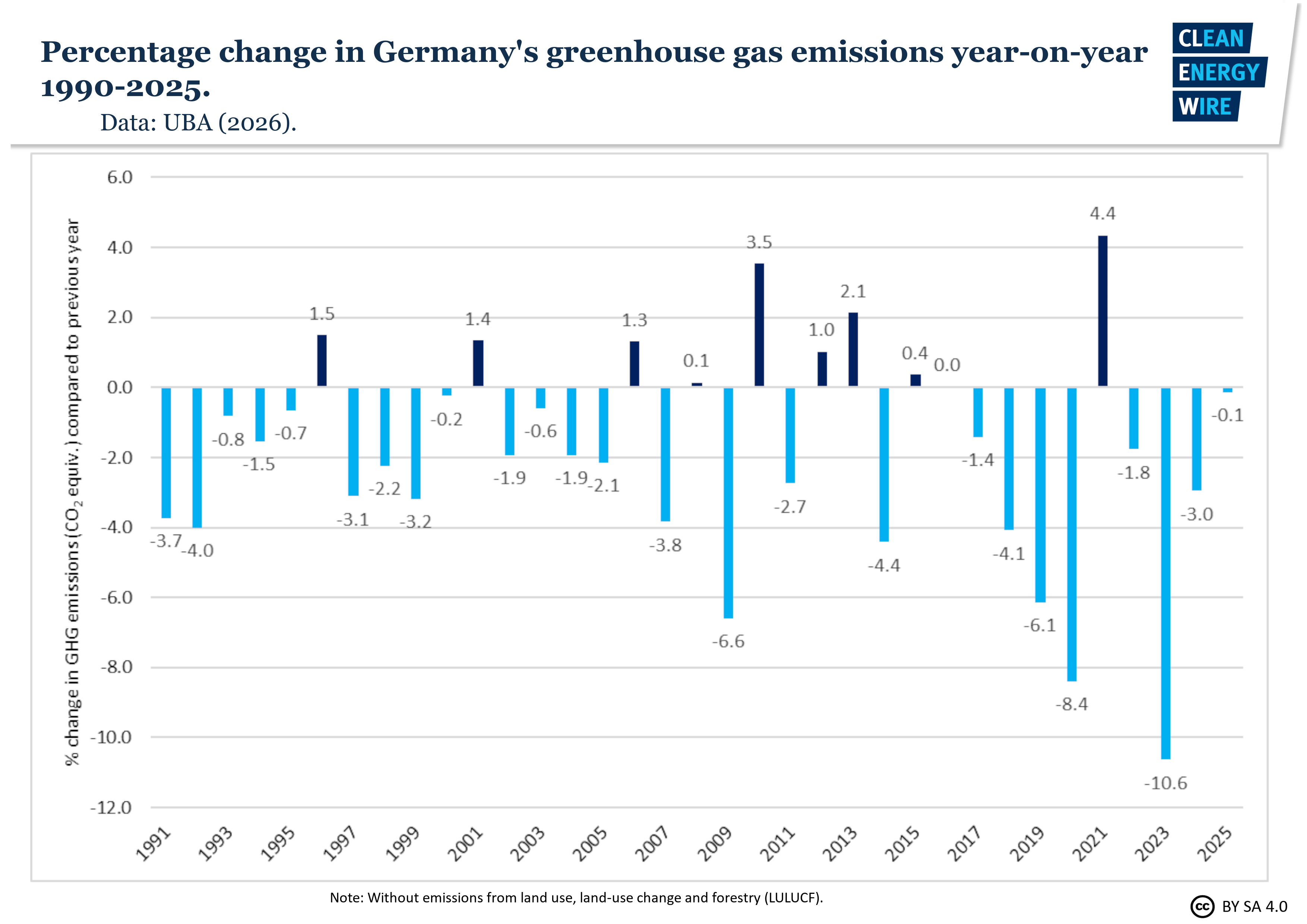
Germany’s greenhouse gas emissions hardly budged in 2025, decreasing only by about one million tonnes (0.1%) compared to the previous year. Emissions from industry declined mainly due to a stagnating economy, while those in transport and buildings increased compared to 2024, clearly exceeding the annual levels stipulated in the country's Climate Action Law. Sales of transport fuels were on the rise and colder winter temperatures increased the need to heat homes, mostly still with fossil fuels like gas or oil. Compared to 1990, emissions in Germany today have fallen by about 48 percent.
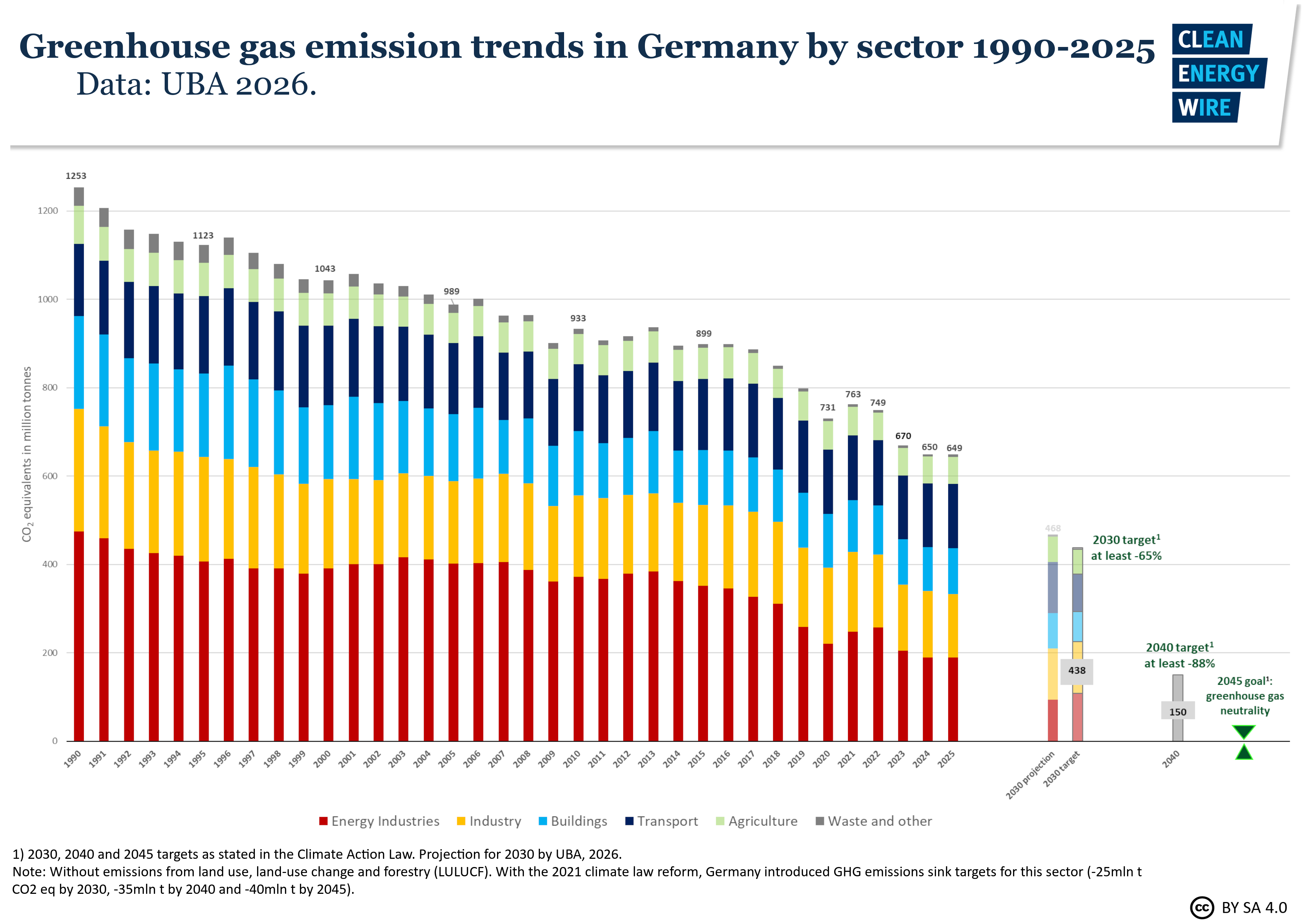
The Federal Environment Agency (UBA) provides the latest and detailed data on Germany's greenhouse gas emissions.
What are Germany's greenhouse gas emissions by sector?
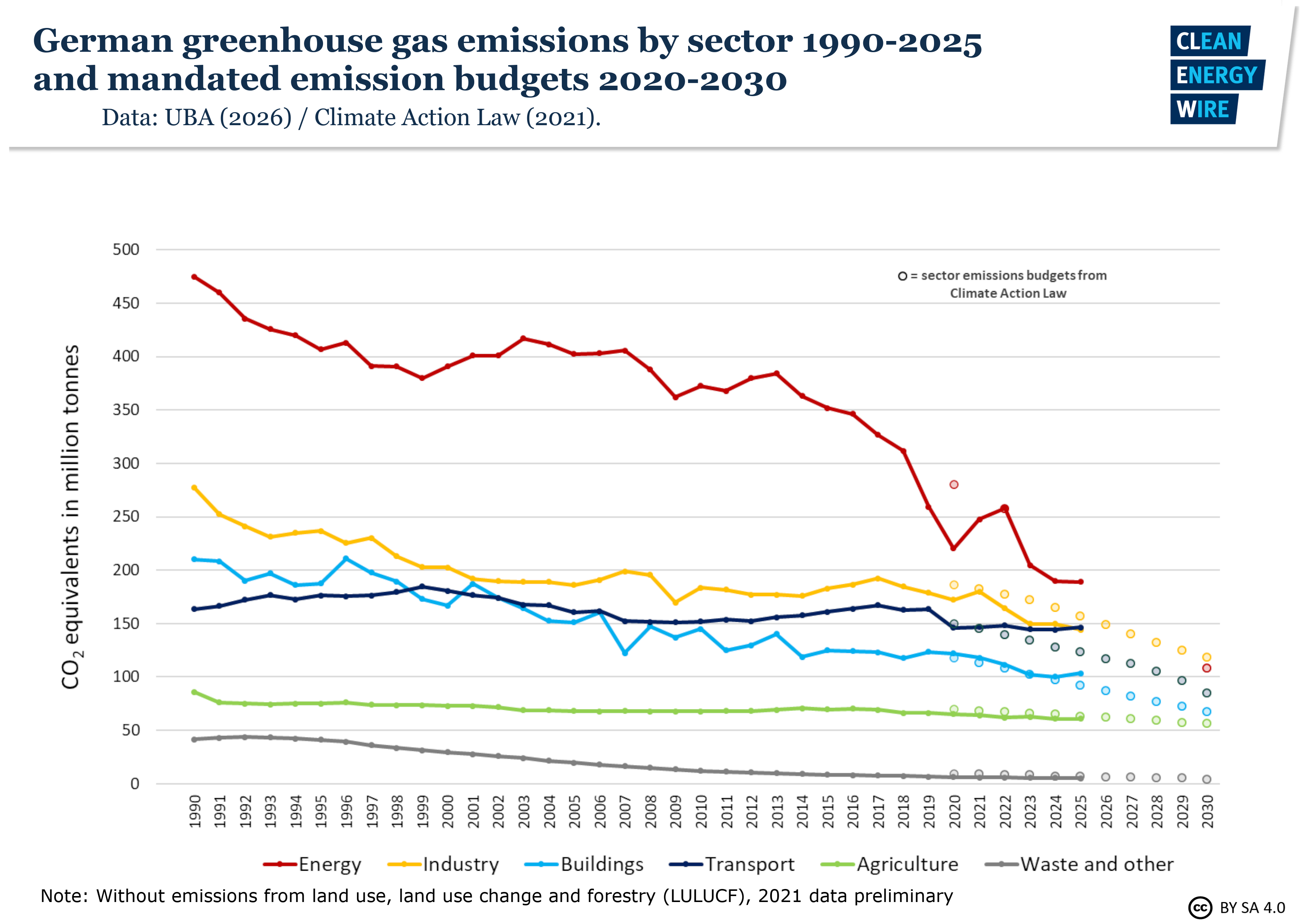
Each sector has an annual emissions budget for the years until 2030 in Germany's climate action law, and all sectors have achieved emission reductions between 1990 and 2025, albeit in widely different volumes.
The energy industry is responsible for the largest share of the country's greenhouse gas emissions, totalling 29.1 percent in 2025. By that year, emissions from the sector had dropped by about 60 percent compared to 1990 levels. This decrease was to a large extent caused by the decommissioning of emission-intensive, lignite-fired power plants in the 1990s, which were substituted by more efficient power plants. In recent years, coal-fired power generation has been increasingly substituted by renewable energy.
Heavy industry is responsible for 22.2 percent of emissions, making the sector the second largest emitter in Germany. Emissions in the sector have fallen by 48.1 percent since 1990, mostly due to an increase in efficiency in production processes. The rising price on carbon allowances since 2019 helped improve energy efficiency efforts and brought down CO2 output, as did the energy crisis with its high fuel prices. A weak economy and resulting low production have driven reductions in recent years.
At 50.8 percent, the building sector has achieved Germany's third largest emission reductions since 1990. In 2025, the sector was responsible for 15.9 percent of total emissions. Building emissions have, however, largely stagnated since 2011, and Germany is a long way from reaching its target of a "nearly" climate-neutral building stock by mid-century.
Although transport was responsible for 22.5 percent of total emissions in 2025, reductions have been difficult for the sector, with emissions remaining largely unchanged from 1990 until the COVID-19 pandemic hit in 2020 (-10.4% in 2025). Despite vehicles being less emission-intensive today, there has been an increase in road traffic with ever larger and heavier vehicles. Together with buildings, transport is an area where Germany must significantly speed up measures in order to reach its overall goal of carbon neutrality by 2045.
Agricultural emissions (excluding LULUCF) have fallen by 29.1 percent since 1990, while they made up 9.4 percent of total emissions in 2025. A large part of this decrease took place in the years after German reunification when livestock numbers were reduced.
Waste and other miscellaneous sectors are responsible for less than one percent of total emissions, but these have fallen by 87.7 percent since 1990. The sector has succeeded in avoiding harmful emissions through reorganisation and by sorting waste.
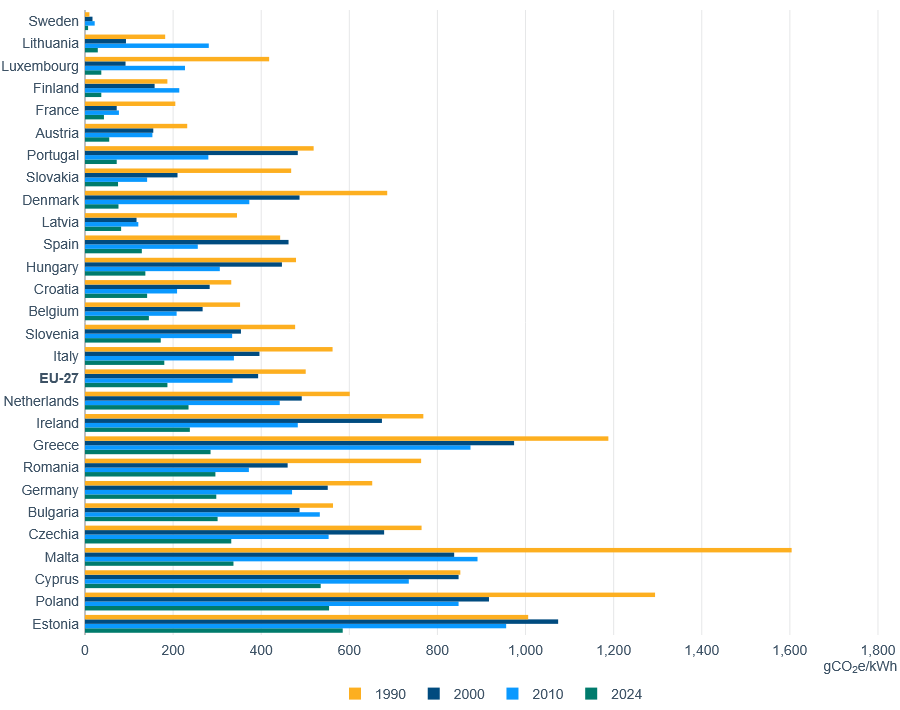
Eurostat: EU greenhouse gas emission intensity of electricity generation, country level
What are Germany's energy transition targets?
The most important tools for Germany to reach its targets on emission reductions are the roll-out of renewable energies, bringing down energy consumption and ending the use of fossil fuels in all sectors of the economy. In order to do this, the country has also set a range of energy transition targets which primarily relate to the expansion of renewable energies and reducing energy demand.
The energy transition is subject to an annual monitoring process, where an independent commission of energy experts provides an assessment. In December 2025, the advisors urged clear phase-out strategies for oil and gas to avoid high costs and supply risks as the use of these fossil fuels declines on the country’s path to climate neutrality by 2045.
Germany's National Energy and Climate Plan (NECP) – a plan each EU member state must submit – lays out Germany's energy transition targets (chapter 1.1.iii.).
What are Germany's targets for renewables expansion?
Germany has made significant progress on the expansion of renewable energies. Since the launch of support payments in the country’s Renewable Energy Act (EEG) in 2000 – the feed-in tariffs paid to operators of renewable electricity installation – renewables have risen from a niche technology to become the dominant player in the electricity mix. In 2025, 56 percent of the country's power consumption was covered by renewables.
However, the development of renewables has not been ambitious enough to reach climate targets. The former government decided in 2022 to rapidly speed up the expansion of renewables, which had lagged behind in previous years. Germany now aims to bring the renewables share in power consumption to 80 percent by 2030. After the completion of the coal phase-out, the aim is to achieve greenhouse gas neutrality in the electricity supply.
The previous government had said that “ideally” it wanted to pull forward the coal exit from 2038 to 2030. However, following resistance in eastern mining states and the lagging expansion of alternatives for times without sunshine or wind (for example gas power plants, later to be converted to run on green hydrogen), the current government said that Germany may have to keep some coal-fired power plants online even longer than planned. It has, however, not put into question 2038 as the final coal exit date.
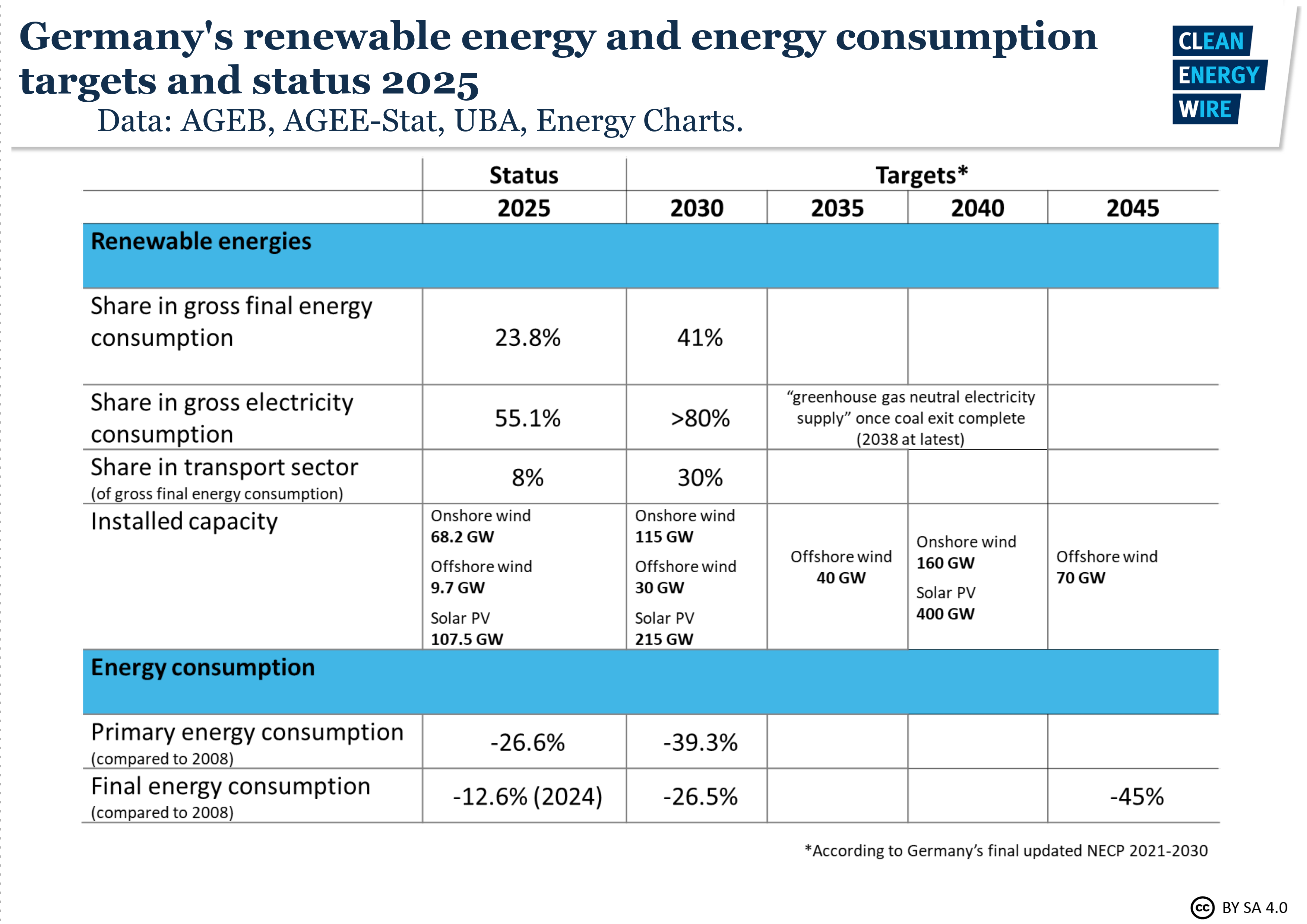
Germany aims to increase its onshore wind capacity to 115 gigawatts (GW) by 2030 and 160 GW by 2040 – from around 66 GW at the end of 2025. Offshore wind power capacity should be increased from 9.2 GW in 2025 to reach a minimum of 30 GW by 2030, 40 GW by 2035 and 70 GW by 2045. The country wants to achieve a total solar PV capacity of 215 GW by 2030 and 400 GW by 2040, up from about 100 GW at the end of 2025.
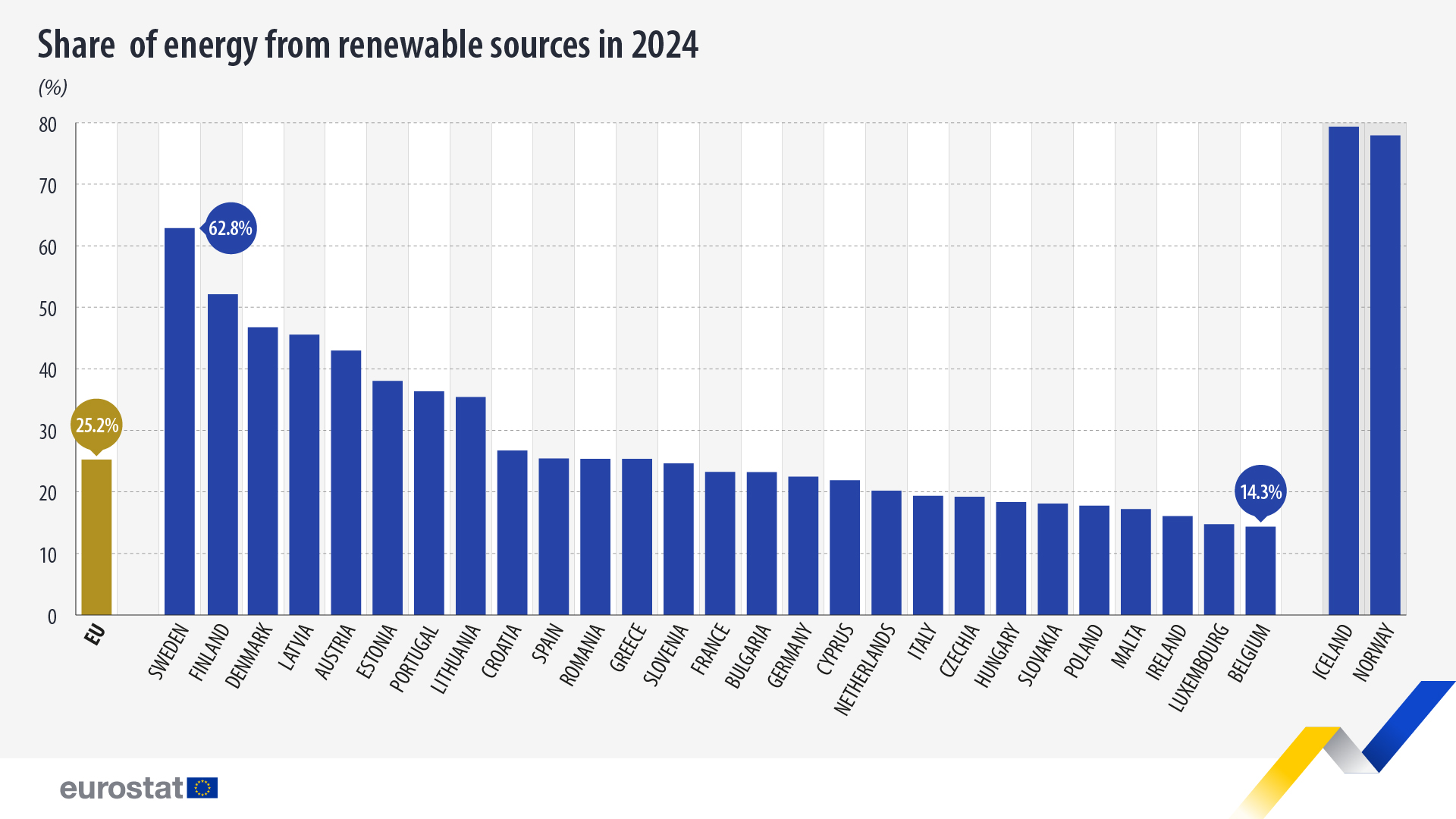
Renewables’ share in the country's gross final energy consumption was 23.8 percent in 2025 – (2030 target: 41%). This puts Germany ahead of many other industrialised nations (note that the share of hydropower in the German energy mix is comparatively low, with most renewable power coming from wind, solar and biomass).
What are the country's energy efficiency targets?
Germany has made less progress on its targets to reduce energy demand than on its renewables targets. Increasing energy efficiency is generally seen as a main pillar of the energy transition and essential to reaching climate neutrality by 2045. Saving energy on a large scale – by insulating buildings, changing behaviour and introducing many new and often expensive technologies in different sectors – requires everyone’s participation, and has proven a hard sell so far.
In 2023, parliament adopted an energy efficiency law, which sets targets to reduce energy consumption relative to 2008:
- Final energy use: 26.5 percent reduction by 2030 (45% by 2045) [status 2024: -12.6 percent]
- Primary energy use: 39.3 percent reduction by 2030 [status 2025: -26.6 percent]
The government said the law corresponds with the requirements of the amendment of the EU Energy Efficiency Directive.
Germany's emissions in a historical context
A look back at Germany’s historical emissions since 1850 reveals that the country’s greenhouse gas emissions have been very much dependent on economic fluctuations and alternations between times of war and peace.
World War One, followed by the economic and political crises of the 1920s and early 1930s, had a very visible influence on emissions, as did the build-up to, and aftermath of, World War Two. Apart from these anomalous periods, Germany's greenhouse gas emissions were on a constant climb until they peaked in 1979 at 1,390 million tonnes of CO2 equivalents.
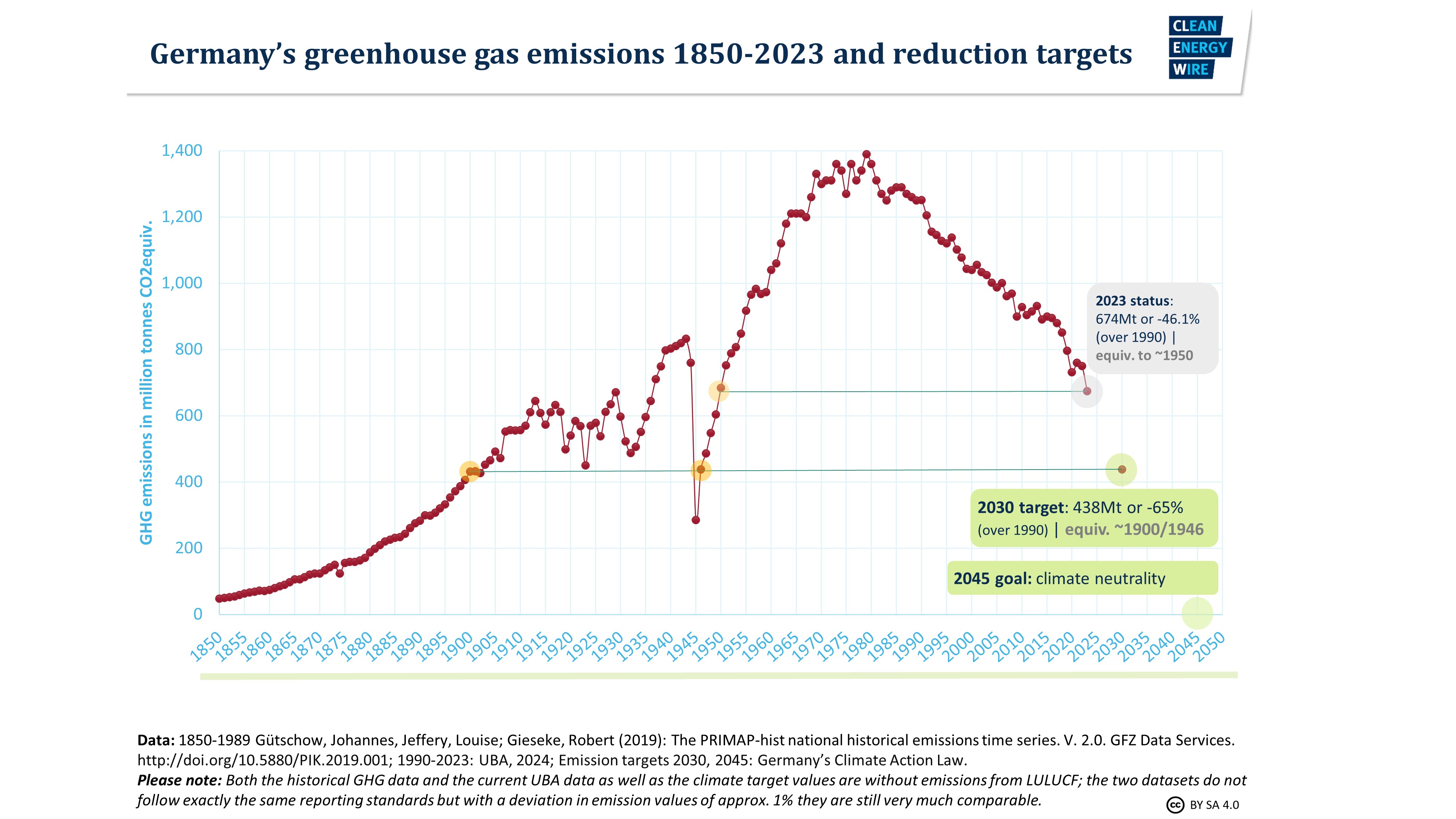
Emissions have been gradually declining since then – also since the international reference year of 1990. Germany was given a head start in 1990 when, following the fall of the Berlin Wall and reunification, the decline of the East German industrial and power sectors meant automatic CO2 reductions (so-called “wall fall profits”). In 2009, emissions dropped by 6.9 percent compared to the previous year due to the global economic crisis, which saw many companies scale down production. However, in the years that followed, the hope that this trend would continue remained unfulfilled. Impacts of the COVID-19 pandemic led to even bigger emission reductions in 2020 when they dropped by 9 percent, and the effects of the energy crisis exacerbated by Russia's invasion of Ukraine caused a 10 percent drop in 2023.
A comparison between Germany's emissions in the past and its current emissions targets sheds light on the amount of emissions the country still needs to cut.
- By 2030, the country must reduce its emissions to levels similar to those around 1900
Although Germany has largely managed to decouple economic growth (measured in GDP) from a rise in greenhouse gas emissions, the record of the past three decades shows that the country will need to implement significant changes if it wants to reduce emissions to meet its targets.
The year 1855 falls within the beginning of the industrial revolution in Germany. For the first time, Germany's fragmented states formed a customs union, which also included parts of today's Poland and the Czech Republic (the data set used for this article generally reflects the emissions from a country’s territory within the boundaries of the time).
The customs union covered an area with a total population of around 32 million, not even half of Germany's current population of around 82 million. Coal mining regions, such as the Rhine-Ruhr area and Saxony, became the first industrial hubs, and the population was growing because of new achievements in medical services and hygiene.
A large share of emissions, 21.6 percent, still came from the agricultural sector, with 62.5 percent coming from energy use and just 1.4 percent from industrial processes. Despite a boom in rail travel (in the 19th century 50,000 kilometres of rail tracks were built in the German territory) the most common form of freight transport for short distances was horse-drawn carts, while people generally used carriages or simply walked.
In-depth explanations on the data can be accessed here.