
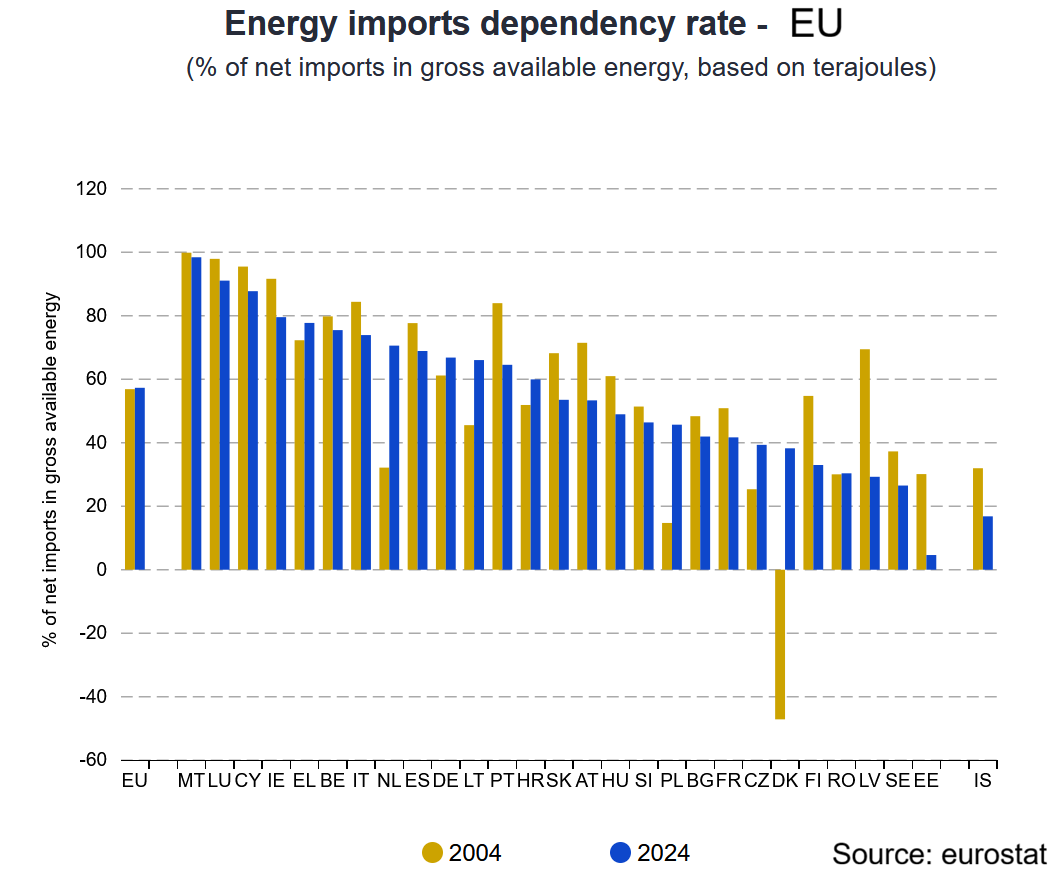
In 2024, the European Union imported 57 percent of the energy it consumed. Germany’s energy import dependency was still higher at 67 percent.
With an increasingly integrated European energy system, the significance of a country-focused analysis of import dependence will decline, and an EU-wide one will come into focus. However, the consequences of the war against Ukraine and the energy crisis also showed that governments often still see energy security as an issue to be tackled at the national level.
1. Energy crises put import dependence in spotlight
The global energy crisis fuelled by Russia’s war against Ukraine put a renewed focus on the debate about Europe’s and Germany’s dependence on imported fossil fuels, and especially their heavy dependence on one single supplier: Russia.
Until the end of 2021, Russia was the main supplier of oil and natural gas to the EU. It was also Germany's main supplier of oil, gas and hard coal. Following Russia’s invasion of Ukraine in February 2022, imports from Russia decreased substantially due to sanctions from both sides and the war’s influence on trade and infrastructure. While not to the same level, dependence on other countries increased, including Norway and the US for fossil gas (see below for details).
The next energy crisis, caused in early 2026 by the US and Israeli war on Iran and attacks on energy infrastructure in the Persian Gulf region, revived debate about the pace of Europe’s shift to renewables especially in transport and heating.
2. What impact will the energy transition have on imports?
Overall dependence on energy imports will change dramatically for some countries as the energy transition progresses. The rapid expansion of renewable energy is likely to alter the power and influence of certain states and regions and to redraw the geopolitical map in the 21st century, said a 2019 report published by the International Renewable Energy Agency (IRENA).
The energy crises of 2022 and 2026 have changed the debate about renewables – from being seen primarily as a tool for reaching climate targets, to also recognising home-grown wind, solar, bioenergy and hydropower as crucial for energy supply security.
The plan to reach climate neutrality by 2045 should all but eliminate fossil fuels from Germany’s energy mix. The German government has introduced interim greenhouse gas emission targets for the years until 2040 with the Climate Action Law. The European Union as a whole aims for climate neutrality by 2050.
As fossil oil and gas are being phased out, many see the need to partly replace them with synthetic fuels. Renewable electricity is converted into hydrogen, methane or synthetic fuel (power-to-x) to serve as energy sources in areas with hard-to-abate emissions, for example in industry, road freight transport, shipping or seasonal energy storage. According to several research reports and government strategies, Germany will have to import significant amounts of these green fuels, because space for generating electricity from renewables is limited in the country and power-to-x fuels could be produced significantly cheaper in other regions of the world. Thus, while Germany will likely reduce its overall dependence on energy imports, it will continue to rely on supply not only from within the European network but also from third countries.
3. European Union’s import dependence
The EU produces large parts of its energy domestically (43%), with about 48 percent from renewables and 28 percent from nuclear in 2024, and the rest mostly from solid fuels like hard coal and lignite, and some from natural gas and crude oil.
Still, most energy needs are met through imports: 57 percent. The dependency on imports has returned to pre-crisis levels after a jump to 62.5 percent in 2022. [Find eurostat data on energy import dependency broken down by product for the years since 1990 here.]
The landscape of EU energy imports changed dramatically during the energy crisis, resulting in a significant diversification. Russia was the main extra-EU supplier in 2021 (by trade value: 25% of petroleum oil, 48% of pipeline gas, 48% of coal), creating “an over-reliance on a single, untrustworthy supplier,” as the European Commission phrased it.
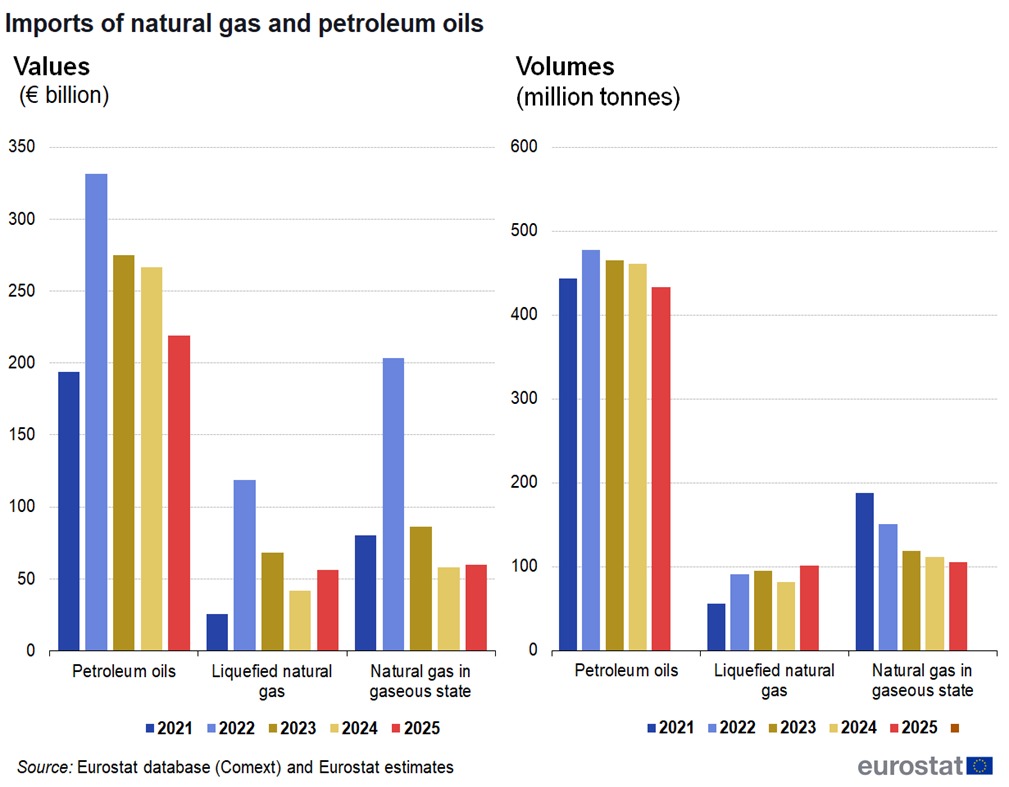
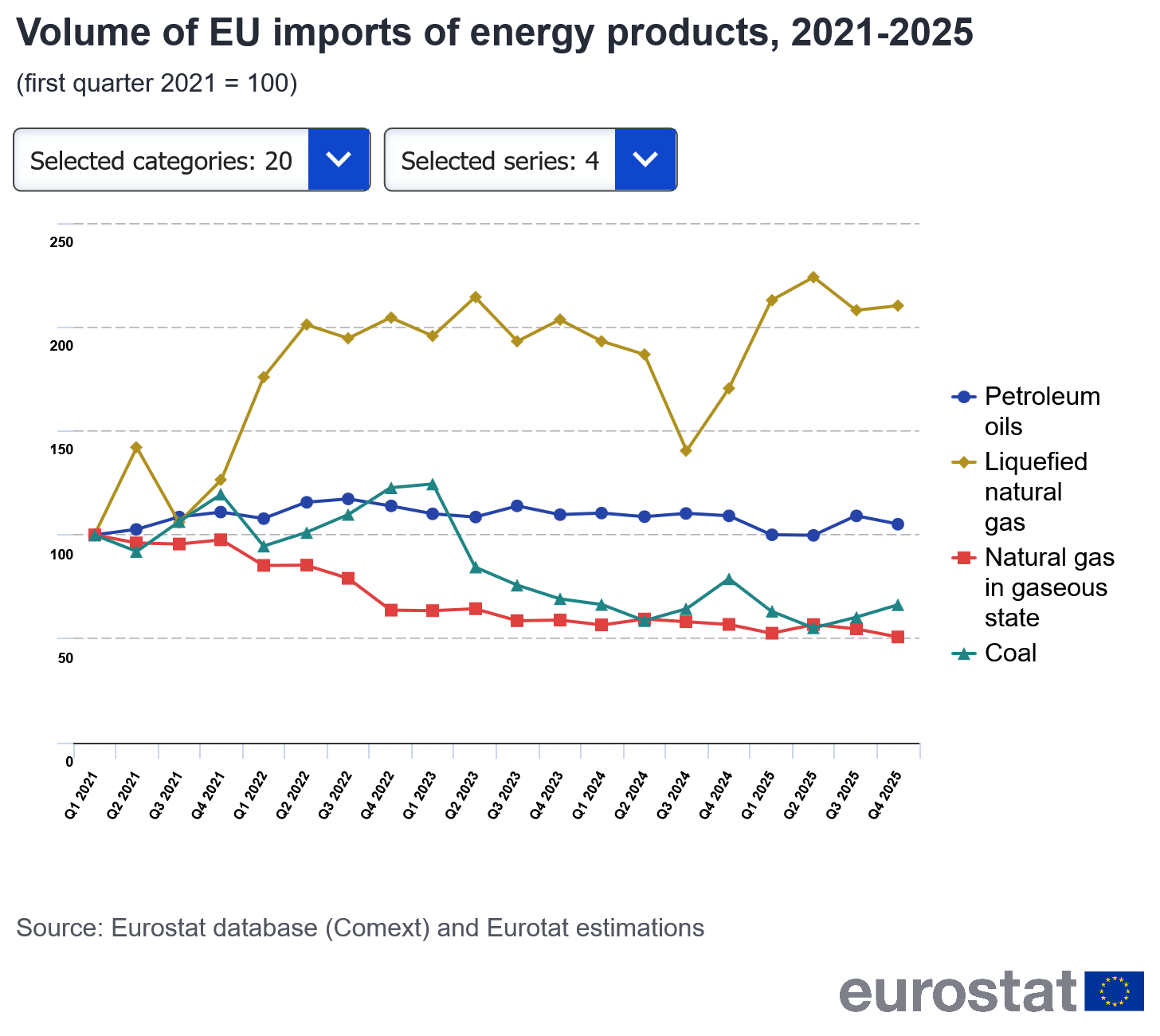
However, by 2025, Russia only supplied a small share of imports. Most oil and petroleum products came from the United States (15% of volume), Norway (13%), Kazakhstan (13%), Libya (9%), Saudi Arabia (7%) and Nigeria and Iraq (both 6%). Most coal imports originated from Australia (31%), followed by the United States (28%), Colombia (16%), Kazakhstan (11%) and South Africa (8%).
Russia has continued to supply a sizeable portion of gas imports, although the EU has decided to fully phase them out by 2027. Most natural gas in a gaseous state was imported from Norway (52%), Algeria (20%), Russia (10%), and the UK (8%) in 2025. LNG came from the US (55%), Russia (14%), Qatar (9%), and Algeria (6%).
[Think tank Bruegel has also compiled information and a dataset on European gas imports.]
Energy import patterns vary widely across the EU member states. While more than 85 percent of energy imports in countries such as Malta and Cyprus were petroleum products in 2024, over a third was gas in Italy. The total import dependency rate in 2024 ranged from 4.6 percent (Estonia) to more than 90 percent (Luxembourg and Malta).
4. Germany's import dependence: oil
Oil consumption peaked at the end of the 1970s, but it remains Germany’s most important primary energy source. Oil covered 36 percent of the country’s primary energy use in 2025. It is mostly used as a transportation fuel, and only a small fraction is used for power production.
According to the Federal Institute for Geosciences and Natural Resources (BGR), about 98 percent of Germany’s primary mineral oil consumption had to be imported in 2024. The country’s domestic crude oil output from 43 oilfields amounted to 1.6 million tonnes that year.
In 2024, Germany imported 84 million tonnes of crude oil (the country also imports additional mineral oil products). In total, 29 countries supplied crude oil to Germany.
In 2021, Russia was by far the largest supplier (34%), but the situation changed significantly with the war against Ukraine. Due to an EU embargo and Germany’s pledge to end crude oil imports from Russia, supplies ceased completely at the turn of 2022/2023. By 2024, Norway (20%), the US (18%), and Kazakhstan (13%) had become the top suppliers.
From 5 February 2023, the EU also banned imports of Russian refined petroleum products, such as diesel fuel.
What impact will the energy transition have on oil imports?
Transport accounts for most of Germany’s oil consumption, which has more or less steadily declined since the late 1990s. The transition to renewables, which has largely been focused on the electricity sector, has had little impact so far. Still, the energy transition has reduced the already minor role of oil in power generation (1% share in 2025 gross power production), because cheap renewable energy has crowded out oil-based generation.
The Climate Action Law stipulates that the transport sector should almost halve emissions by 2030 compared to 1990, which means oil use must decrease significantly. One key element of Germany's climate policy to get there is electrifying the passenger car fleet, but progress has been slow. The government has abandoned the target of 15 million EVs on Germany's roads by 2030. For certain modes of transport – such as freight trucks – imports of synthetic fuels could become necessary.
Official scenarios for Germany's future energy system foresee petrol and diesel use for passenger cars falling by about 40 percent in the decade from 2020 to 2030, and then down to negligible levels by 2045. For trucks, diesel use would more than halve by 2030 and decrease to zero by 2045.
5. Germany's import dependence: fossil gas
Gas covered a little more than a quarter of Germany’s primary energy use in 2025, making it the country’s second most important energy source. Germany is among the world’s biggest natural gas importers – around 95 percent of its gas consumption is met by imports, according to energy research data group AGEB. In 2024, the country produced 4.4 bcm of natural gas, but according to geologists, the fields are nearing depletion. Domestic natural gas production has been falling since 2004 and will likely cease altogether in the course of the 2020s or 2030s.
While Russia’s war against Ukraine has reignited the debate about the possibility of unconventional fracking in Germany, legal restrictions, opposition from the population, and the goal of climate neutrality by 2045 make its use very unlikely.
Germany’s gas imports had been dominated by Russia for decades, but the start of the war against Ukraine in 2022 completely changed the landscape. Right before Russia’s invasion, 55 percent of gas imports came from Russia, 30 percent from Norway and 13 percent from the Netherlands. Germany was also a major gas transit country.
Germany stopped receiving pipeline gas from Russia in late August 2022. While there was no EU embargo on natural gas, the government said shortly after the start of the war that it intended to reduce the share from Russia significantly over the course of two years. However, Russia itself reduced supplies step-by-step and halted them completely in the summer of 2022, shortly before explosions destroyed the Nord Stream pipelines – the only direct gas links between Germany and Russia. [Also read the factsheet Gas pipeline Nord Stream 2 links Germany to Russia, but splits Europe.]
Energy industry association BDEW said that Norway has now become Germany’s top gas supplier by far, with about 45 percent in 2025, transported by pipeline. Around one tenth of the gas used in the country arrives as liquefied natural gas (LNG) directly at one of four import terminals along the coast. In 2025, around 95 percent of that LNG came from the US.
The origin of much of the remaining gas crossing the border into Germany from neighbouring countries like Belgium, the Netherlands, France and Denmark is difficult to attribute, said BDEW. It includes supplies from a variety of world regions, with the US, Algeria and Russia as major suppliers. Thus, Russian gas arriving as LNG in ports in Spain, France and Belgium still ends up in Germany’s gas grid, even as direct imports have ceased. Think tank Agora Energiewende said that about a total of one third of Germany's gas imports came from the US in 2025, if the US share in imports from neighbouring Belgium and the Netherlands is taken into account.
Gas used to be imported to Germany exclusively via pipelines, but the war prompted former chancellor Olaf Scholz to decide to set up a domestic import infrastructure for LNG. The first floating terminal was built in record time and went online at the end of 2022. There are now four facilities in operation, with more under construction.
Several reports have criticised the size of Germany’s LNG infrastructure plans. These are “massively oversized” and state involvement means that taxpayer money is used for what could eventually become stranded assets, said a report by think tank NewClimate Institute in December 2022.
What impact will the energy transition have on gas imports?
Germany’s plan to become climate neutral by 2045 also means fossil gas will have to be largely phased out by then, while the use of renewables-based gases like hydrogen is set to increase.
Currently, most fossil gas is used in the industrial sector (e.g. for power and heat supply, or in chemical processes), followed by private households (mostly for heating), public power and heating supply, and manufacturing and trade (also for heating). Natural gas consumption in transport is marginal.
The lion's share of gas is burned to produce heat, and only a fraction (~13%) is used to produce electricity.
Germany’s government and many experts see natural gas as a bridge to a low-carbon economy because it produces much less CO₂ when combusted than either coal or oil. However, fugitive emissions, such as the leakage of methane during production and transportation, need to be taken into account to evaluate total lifecycle greenhouse gas emissions. Gas complements fluctuating power supply from renewables rather well, because modern gas-fired power stations (unlike coal) can switch from idle to full output within minutes if necessary. Thus, Germany wants to build new gas power plants, later to be converted to hydrogen.
Germany's previous government argued that the planned exit from nuclear and coal-fired electricity generation would push up mid-term gas demand. However, as most gas is used to produce heat, the influence of changes in the electricity sector will be minor. Total gas consumption has remained relatively unchanged since a drop during the energy crisis.
Many analysts doubt that it will rise over the course of the energy transition as efficiency increases and renewables, storage and ultimately renewables-based gases (such as green hydrogen) will cover more and more of the energy need across Europe. Mid-term projections for EU and German gas demand vary widely, many forecasting a decrease by 2030, and a sharper fall thereafter.
Power-to-gas – the process of converting electrical energy into methane or hydrogen for direct use or long-term storage of renewable power – has yet to be used on a larger scale. The federal government strongly backs green hydrogen in its quest for climate neutrality, and says much of it will have to be imported.
6. Germany's import dependence: coal
Germany’s largest domestic fossil fuel source is coal, but its consumption has decreased significantly in recent years, with a temporary rebound in 2021 and 2022 – first due to unfavourable weather conditions for renewables and high gas prices, then also due to government efforts to bring coal plants back online to replace gas use in power production during the energy crisis.
Germany still extracts lignite (or brown coal) from opencast mines for power production on a large scale – 84 million tonnes in 2025 – and imports very little. For years, Germany was the world’s biggest producer of lignite – which emits particularly high levels of CO₂ – and the country still has extensive deposits. Lignite covered 7 percent of Germany’s primary energy use in 2025. Most is burned for power generation (15% of Germany’s gross electricity production in 2025) or district heating.
Due to unfavourable geological conditions, German hard coal is not competitive on the international market, and subsidised hard coal mining ended in 2018. Germany now has to import all the hard coal it uses, mainly for the energy sector (e.g. for power generation: 6% of gross electricity in 2025) and for steel production. Hard coal covered seven percent of Germany’s primary energy use in 2025. [See the CLEW factsheet on coal for further details.]
Hard coal imports have decreased significantly over recent years, from more than 40 million tonnes in 2019 to just over 25 million tonnes today.
Germany’s leading coal suppliers in 2024 were Australia (33%), the US (28%), and Colombia (13%). Before the war against Ukraine, about 50 percent of Germany’s coal imports came from Russia. Due to an EU ban, Germany largely ceased to import Russian coal in summer 2022.
What impact will the energy transition have on coal imports?
Germany around 2020 decided a shutdown timetable for lignite plants and introduced auctions to compensate hard coal plant operators for early decommissioning – all with the goal of a coal exit by 2038 at the latest.
Germany’s former coalition government had wanted to pull forward the phase-out of coal to 2030, and made a relevant deal with the western German mining region. However, eastern states were reluctant to agree to an earlier phase-out. Chancellor Friedrich Merz in 2026 said that some coal-fired power plants might have to be kept online longer than planned to ensure supply security, because plans to build new gas-fired power plants to back up intermittent renewables feed-in have been delayed. Merz did not question the final 2038 deadline.
Germany also aims to have a largely decarbonised electricity supply by 2035, and projections show very little to no coal will be used by that year. The rising carbon price in the European Union Emissions Trading System (EU ETS) means that coal-fired electricity generation and heating become increasingly uncompetitive. Research reports show coal is set to be pushed out of the market by 2030.
However, supply security needs could force Germany to keep coal plants online longer, until sufficient gas-fired units can be brought online. This could result in an expensive system of reserve capacity, even if the plants actually run very little.
In the past, critics of Germany’s push to reduce the use of CO2-intensive lignite had said the country should not abandon its only sizeable domestic energy source. Mining union IG BCE, for example, warned in 2015 that the energy transition can only succeed if Germany does not play “Russian roulette” with its supply security. The union argued that “domestic energy sources ensure German companies do not become even more dependent on price and supply fluctuations on world markets. Our lignite can guarantee this in a balanced energy mix.”